
Main Site Links:
1 music
2 business
3 prcome.org
4 thefea.org
5 bassclarinet.et
6 in the news
[email protected]
BlogRoll
Jeff O'Heir on crn.com


 DrapBlog
Elegy for Lauren Hoffman
Today was one of the most difficult days of my life. On Saturday, one of my eldest daughter Shayna's friends, Lauren Hoffman, was suddenly killed when a truck went out of control and slammed into her car during bad weather. The funeral was today, and not only was it tragic, but heart-rending, a horrible loss for our entire community.
The College Music Society had issued a call for scores for their 2008 national convention in commemoration of their 50th Anniversary - 50 scores would be selected, each limited to around 50 seconds each. I knew I wanted to submit something, but wasn't feeling inspired.
When I got home from the funeral with my girls, I felt the need to express myself through music, and composed the following lament:
http://www.xb5.com/mp3/elegy.mp3
This piece is too short, like her life. I don't know why things like this happen. It all seems so wrong and unfair. She was only 17...
I recently received news that the Columbus Symphony was melting down ($4 million loss over the last two years), so I wrote to one of their musicians who was an Eastman classmate of mine to find out what happened. It resulted in the following email that I sent to the chairman of their board of directors. To date, I have not received a reply.
Dear Mr. Trafford:
I write to you not as a critic, but as a friend of the Columbus Symphony, a group with which I know you have devoted an enormous amount of effort and energy in addition to your busy law practice.
I'm not writing to you to put in my two cents about what you should do about the current dilemma that the orchestra is facing. Short of donating $4-5 million dollars, I'm not sure I can be of much help.
Rather, I am writing to you to espouse some ideas that might be useful food for thought for the future. I also write to you from the unique perspective of someone who has been both a major symphony orchestra musician, and a C level executive with a quarter billion dollar logistics firm. Indeed, my last position was as a principal in the business strategy group of a $2.5 billion telecom firm. I also went to school with some of your musicians. I wear two hats, and mix the two by teaching and training musicians to be entrepreneurs for the arts.
I will be blunt. I believe your orchestra needs to be completely restructured if it is to have a future as a vital part of the Columbus arts community. I see your orchestra wavering under a by-gone model that has administration pitted against musicians, with both losing. Both groups are culpable, and unfortunately it is an archaic model all too common in American orchestras. On one hand, the administration views the musicians as a group of savants that cannot do anything beyond playing their instruments. The musicians, for their part, look at the administration as having only one goal: raise more money to increase their salaries.
Both are flawed approaches.
I found it noteworthy in visiting your orchestra website, that on the orchestra personnel roster, they also list who is their collective bargaining representative. I found that the musicians also maintain their own website, separate from the organization. To me, these are small indicators of a pathological organization, one where you have enmity within itself, let along cooperation, kind of like an animal that feeds on its own limbs.
I've spent a lifetime with orchestra musicians, and believe that they can be tremendous assets beyond the mere playing of their instruments, and are a huge untapped and wasted resource in your organization. While they tend to be a conservative lot, they are remarkably devoted and self-disciplined and self-motivated individuals. You need to tap into this wellspring of talent and draw them into the success of the organization, rather than ignore them. They are smart people that can possibly make the difference between a thriving successful arts organization, and one that loses almost $4 million over the last two years.
Similarly, you need to rethink your community outreach and marketing approaches and be creative. This is a huge challenge. Maestro Leonard Slatkin recently said he does not "anticipate much more than 4% of the population as regular concertgoers." What marketeer would ever ignore 96% of the marketplace when trying to sell a product to the public?
If I was going to start an arts organization, I would never start a symphony. It is too costly to put all those musicians on stage, and that is why we both know that orchestras are inherently money losing organizations, where ticket prices represent only a fraction of the cost of putting on the concert. We also face a dying demographic amongst our clientele. Go look at your audience - look at the gray hair! This is a diminishing group that needs a fresh influx of interest. Even the New York Philharmonic faces the phenomena where people donate money, but don't go to concerts. Instead, we need to communicate to the entire public why we are moved by this music. Tenor Paul Potts did this in an astounding way last summer, and with opera, no less. If you haven't seen this video, you should:
http://www.youtube.com/watch?v=1k08yxu57NA&
You also need an administrative and development staff that understands this, and is willing to be creative AND tap the huge resource that you have been ignoring - the orchestra musicians - and rethink your approach to selling the Columbus Symphony. If you continue down the same road, you will continue your downward spiral and lose more millions. One definition of insanity is doing the same think over and over and expecting a different result. I believe you need to chart another path for the Columbus Symphony.
What I am espousing is not a new concept; it is one that is or has been adopted by a number of similar-sized orchestras in America, including the St. Paul Chamber Orchestra and the New Jersey Symphony. I would be glad to introduce you to my old friend Bob Wagner, who is one of the leaders of the League of American Orchestras. It might be useful to have a phone conversation with him about some new approaches.
So, to summarize, I believe you need to restructure your organization, including its marketing approach, and move to a collaborative model where everyone - including the musicians - work together and have a personal stake in the success of the organization. I know it is easy for me to say this and difficult to implement, but clearly the methods of the past do not work unless you are willing to let the Columbus Symphony degrade into a part time orchestra with a limited season.
I beg your forgiveness for this presumptive email, but I am passionate about music. If there is anything I can do to be of assistance, please do not hesitate to let me know or contact me.
I wish you the best of success in all of your future endeavors.
Sincerely Yours,
mld
In the beginning of July, I penned the following essay to the NETMCDO email list, and this formed the basis of my opening speech at the North Carolina BCOME conference, on July 27, 2007 at the Brevard Music Center.
Folks:
After reading the depressing NY Times article "Why Isn't Classical Music Front And Center" (see below), I still can't accept the notion that classical music is dying and will perish from the earth, or will at best be totally marginalized in our society. Even though I have somewhat taken on a role of evangelist for music entrepreneurship, and even though it appears that most music schools are still graduating thousands of music performance majors into a society that does not see "classical music" as a primary musical priority in their lives, I still cannot give up the notion that there is great value in what I have been taught about music. But frankly, I am just not sure how that value should be communicated, and that's what we are all struggling with.
Perhaps it is the venue. I have to admit that I would rather take my family to a park band concert (and get less objections) where we can spread a blanket, sit on comfortable beach chairs, sip wine and munch on noisy potato chips, talk when we feel like it, than to get dressed up, sit in uncomfortable theatre seating (always a challenge for me, being 6'6"), sit still and be quiet in a concert hall. I went to hear the Berlin Philharmonic perform Ein Heldenleben at Carnegie a couple years ago, and it was as if I was at a funeral - everyone sitting perfectly still during some of the most rousing music ever written, performed by one of the world's great orchestras.
Perhaps it is the medium. I attended Fromme Week (or "Crazy Music Week" as we called it) when I was a Tanglewood Fellow, thinking of how much we were on the leading edge of music. Leading edge of what? Over the years, I've attended concerts with "contemporary music" and come to the conclusion that folks by and large don't like it and I have been to New York Philharmonic concerts where I have actually heard the audience boo, and loudly. Or perhaps they do like it, but when it is in the context of film music, like strings playing in dissonance during a tense scene, or aleatoric music when portraying aliens. While everyone understands that context, few seem to want to go to concerts to hear "contemporary" music. How many folks do you know that bubble with enthusiasm as they proclaim, "I love atonal dissonant music! I am so moved." I don't intend demeaning sarcasm here; I merely wish to illustrate a point. The only exception I can think of was when Philip Glass's minimalist music became trendy, and I had yuppies asking if I could get them tickets - this was a rare exception. We all laughed at the Elliot Carter April Fool's Day joke email that I recirculated about a month ago, but what made that missive extremely clever was how close to the mark it came, and in no disrespect to Elliot Carter, try to name one piece of his that you can hum off the top of your head.
We all know the examples of classical music making it into popular culture - Bach appearing Beatles tunes, Rite of Spring and Mars from Holst Planets, Barber Adagio, Ride of the Walkures going into films, Clair de Lune in Ocean's Eleven. Perhaps it is the context....maybe we need to get unstuck from the notion of the concert hall as the primary purveyor of music, to something else...if we want to reach an audience. When the Goldman Band was in its heyday performing 50 concerts a year in New York's Central Park, it was said that most New Yorkers learned about classical music listening to their park concerts - not from the Philharmonic - where they weaved in transcriptions of Dvorak symphonies along with marches, show tunes and other music not considered "serious."
I also can't help but notice where the composing giants of our time have gone, and we all know that historically composers have followed the money trail, unless you follow the Charles Ives model and compose avocationally. John Williams writes phenomenal music for film, Andrew Lloyd Webber writes phenomenal music for the stage, Paul McCartney and his compatriots write phenomenal popular music -even Leonard Bernstein, our protean classical music genius of the 20th Century, is largely known as the composer of the Broadway musical West Side Story - is it heresy to agree with many peoples opinion that "Maria" is the finest art song of the 20th century? You can point out that John Williams conducted the Boston Pops for many years, but I will bet you that he conducted to much larger audiences than the Boston Symphony. So many of our giants wrote for film - Copland wrote the score for "Of Mice and Men" and "Our Town" (for which he received Oscar nominations), Malcolm Arnold wrote the score to "Bridge Over the River Kwai" (for which he did win an Oscar) and the list goes on and on. What do they know that we don't?
I was recently asked to consult on marketing for the Austin Symphonic Band, one of the finest concert bands in the nation. They wanted to figure out how to get more people to come to their regular concerts (as opposed to their park concerts). My response was, "why?" They were getting a nice audience of friends and family. I told them that they could probably go to a lot of effort to try and market the group to the general population, but I doubted that they would get much traction in getting many more people to go to a concert hall to hear their music. Instead, enjoy the wonderful concerts they are doing with their current audiences, and perhaps look elsewhere - perhaps getting into Austin's South By Southwest (SXSW) and accompanying (as an 90 piece ensemble) some big popular artist, and that will raise the awareness of the band in a way that they could never achieve in trying to market their concert hall programs. Maybe the conclusion here is that if you want to put on classical concerts in concert halls, you need reasonable expectations in our society and culture - be happy that people are showing up at all, and figure out some combination of subsidization or low expenses in order to finance them.
I'm not advocating that we musically "sell out," but I seriously question the financial viability of "classical music" in the way that it is currently being presented and I abhor the fact that we continue to blindly graduate performance majors and continue to hold the Symphony Orchestra as the shining model of what what we should aspire to in our "classical" careers. Instead, we need to be continuing to look at the fundamentals of what drives us as artists and how we can get that message to those that might be receptive to our message, and not be hampered by the old 19th century structures, such as the symphony orchestra, and rethink how we can achieve success in doing so. Rather than having to raise $20,000 to put a 60 piece professional symphony orchestra on stage for one concert, maybe that means following the Charles Ives model and sell insurance so that we can write revolutionary music and not care whether it generates an income. Maybe it means writing music for the likes of something like World of Warcraft, which as of last counting has 7 million subscribers. Wouldn't you want your music to be heard by 7 million people, even if they are gamers?
Have you taken a look at Spoken Word (http://en.wikipedia.org/wiki/Bowery_Poetry_Club)? Poets have transformed themselves into performers and found a powerful medium for communicating their poetry. If poets can do it, anyone can!
I think we need to continually rethink about what we are doing, and the guidance we are giving those who come into our academic folds with dreams and stars in their eyes, and continue to push the notion that the world awaits them. Perhaps not as a symphony player, but as a purveyor of what moves them as artists in some other form. My Eastman clarinet teacher Stanley Hasty used to encourage us by telling us, "if you are good, there will be a symphony job out there for you." I would now modify that to the following: "If you are good, there is a way that you can earn a living and communicate your artistry to an audience out there."
The New York City Musician's Union paper posed another question: "Labor Day is Sept. 3, a day when this nation recognizes the role of working people and their unions. As a professional musician and a union member, do you view yourself more as a 'worker' in the entertainment industry or more as an 'artist'? Who do you believe you have more in common with: other 'workers' -- or those who view themselves as 'artists'? Regardless of your answer, should musicians care about the labor movement?" Here is my full response:
I once had a friend who was an artist - a painter - who questioned whether musicians qualified as "artists" since we primarily reproduce music that was written by someone else.
Certainly, if we judge painters by whether they are performers or not, we would similarly question whether they were artists. Even further, as musicians, we are trained to be followers from the moment we set foot in an ensemble, not as leaders.
The issue of whether we are labor or artists, or leaders or followers is secondary to the larger issue of what we want our music world to look like, and what we decide should be our role in that world, which continues to change and evolve as we speak.
If one limits their view of the world of musicians to one where we relegate ourselves to being labor, or in the case of freelancing, contract labor, then I suppose that unions and collective bargaining take on a more important role. But as we all know,
music has been transforming itself through an increasingly digital age, with more music now being distributed through electronic media than through the concert stage.
The challenge we have, as musicians, is our legacy of always working for someone else, whether it be for a symphony or pit orchestra, and as we all know, those opportunities are shinking. Are you content to be an "artist" solely dependent on others hiring you (which categorizes you as labor), or do you take control of your destiny and seek alternative means of expressing your art, and becoming the employer rather than the employee?
Ever since Ronald Reagan became President, the arts in America have suffered a slow decline due to both reductions in government subsidies as well as a public that has turned their interest to other genres than the ones in which we have been trained.
However, music itself is alive and well in our country, but it is now being distributed by the likes of Sony Music, aired on the radio by Clear Channel and played on iPods made by Apple Computer.
Are we merely music labor scrambling for jobs in live music in a digitally recorded and regurgitated world? Where does that leave us?
Amazingly empowered, is the answer. The labor movement may be dead when it comes to music, but we live in a time when we have unprecedented access to our listening public through the internet and other forms of distribution. No longer are we limited to what record companies decide to put on store shelves. We now have the
ability to seek out our niche market and find a way to make money off of it. But only if you are an enterprising musician, and not an artist that feels that they should be entitled and served by non-existent employers.
This isn't the 19th century - the world has moved on, so be a force for change rather than inertia. Where there is change, there is opportunity, and the real question is whether you can look beyond the end of your music stand for what
awaits you in our amazing world.
The following is an email I sent to Joel Seligman, the new President of the University of Rochester, my alma mater. I penned this on the occasion of their announcement of Douglas Lowry's appointment as new dean of the Eastman School of Music. So far, I have not gotten a reply.
Dear Dr. Seligman:
I am very concerned that Eastman has or is on the verge of losing its leadership position in the music world, and hope that the appointment of Douglas Lowry as Eastman's new dean may give us a new opportunity to halt Eastman's slide.
I am writing to you after attending the Kauffman Campuses Annual Workshop in Kansas City as a guest participant, as a graduate of the Eastman School of Music of the University of Rochester, a former major symphony clarinetist, a business executive and strategist and many other things I can list in my title and bio. I have also had a close relationship with several of your previous Eastman deans. I consider Bob Freeman a good friend, and met about every six months with Jim Undercofler. I have also lectured, performed and given master classes at my alma mater. I have been proud to be an Eastman graduate.
I am also the Executive Director of the Brevard Conference on Music Entrepreneurship (BCOME), held each summer at the Brevard Music Center in the Blue Ridge Mountains of Western North Carolina, which has been funded with generous grants by the Kauffman Foundation. BCOME has assumed the position of mover and shaker in entrepreneurship in music, and an incubator and educator for the academy, and indeed it has been attended by two previous Eastman deans, Bob Freeman and Jamal Rossi. I was also recently appointed to the Committee on Career Options and Entrepreneurship of the College Music Society, and I have lectured at their National Conference for three years in a row.
My interest in helping to restructure the classical music world into line with the rest of our entrepreneurial capitalist economy was sparked in 2000 when Bob Freeman invited me to be keynote speaker at a symposium he held at the University of Texas at Austin College of Fine Arts where I posed the following question:
"Where are the incubators of the fine arts world?"
At the time, I was an executive in one of the leading web design firms in New York's Silicon Alley (in fact I personally managed our Carnegie Hall account) and saw the changes that were occurring in the United States.
I subsequently echoed this concern to Jim Undercofler, whom I met when I gave a master class and lectures in Eastman's Arts Leadership Program two days after 9/11. I asked him how in good conscience he could continue to graduate musicians into a marketplace he very well knows doesn't exist - our academies of music graduate roughly 16,000 music performance majors into a society that only supports 22 full time full year symphony orchestras, and that number is dropping. He invited me to meet to discuss the issue with him, and I told him that musicians graduating from Eastman need a third career path more in line with the rest of America besides teaching and getting a job working for someone else.
I didn't start out intending to be a moving force for "music entrepreneurship"; I didn't even use that word. Having worked with over 30 startup companies to the Fortune 500 and Wall Street, I just felt that musicians should be able to forge their own career paths as almost every other industry in our country does, especially having lectured on the subject as the Chair of eCommerce Management at Columbia University and as a lecturer at the University of Chicago.
In our meeting, Jim offered Eastman's efforts in their Arts Leadership Program and Institute for Musical Leadership, a program started by Doug Dempster under Bob Freeman's leadership. I told him that I had looked over all of the courses in those programs, and very little or none of the courses had anything that would solve the problem ("Viola da gamba ornamentation"). It was clear that the program had degraded into a catch-all for non-credit courses. Indeed, you have an Institute for Musical Leadership that ironically doesn't teach leadership, and when I was at the Kauffman shindig, there was much discussion on how Eastman squandered their million dollars in Kauffman money with little or nothing to show for it - no leadership and certainly no entrepreneurship. The term used to describe Eastman at the Kauffman meeting was "missed opportunity." ALP and IML are both nice titles with no substance.
Jim did challenge me to create what I thought would be an appropriate curriculum and degree program for Eastman, and I did so, and he had me present it to a select group of Eastman faculty. By and large it went the way we thought it might: one third were very excited and said "Drapkin, how soon can you implement this?" One third were ho-hum and didn't care, and one third didn't want to have anything introduced into the curriculum that would distract their students from spending every free waking moment practicing their instrument.
I urged Jim to implement entrepreneurship as part of the Eastman curriculum and told him that I thought it would have the most profound effect on music in higher education since Freddy Fennell founded the Eastman Wind Ensemble.
Following that presentation, Jim told me that he "couldn't implement such a program because his Humanities Department was out of control and they controlled all non-musical elective courses." It made me wonder who was running the school. Eastman was a lost cause.
The grand irony of this debacle was Jim contacting me prior to our first Brevard Conference a couple years ago where he said "Michael, it is bizarre that Eastman isn't involved with BCOME given our ALP and IML programs." I told him "great...I would love my alma mater involved. Who do you have that can lead a session on anything to do with entrepreneurship?" "No one" was his reply and that ended the discussion.
Also ironic is that Juilliard, who has been blasted in the NY Times for catering to the chosen few and abandoning or ignoring most of their students, threatens to eclipse Eastman due to Joe Polisi's hiring of the very capable Derek Mithaug as the Director of their Office of Career Development. Derek is now the Chair of the CMS committee of which I am a member, and Eastman is nowhere to be found, even though I constantly badgered Jim Undercofler to get Eastman involved. The irony is that I have met with Joe Polisi, President at Juilliard, and challenged him to transform Juilliard from a 19th century trade school model still in use in most music academies in America where faculty tell high school students that if they come and study with them that magically someone is going to hand them a job in their field. I cajoled him to come into the 21st century, and he proudly told me that he was championing a Juilliard program to teach his students to better read and write. Can you imagine a head of a college considering it innovative to teach college students to read and write? Yet, Juilliard, with Derek at the helm, has been assuming the leadership position, while Eastman has squandered opportunity after opportunity and wasted its Kauffman money.
If anything is "bizarre" it is that I am now working with Juilliard on a national basis to address the issue of "Career Options and Entrepreneurship" instead of Eastman.
How do we judge the worth of a music academy? By the size of its endowment (Eastman's quarter billion) or the number of students it graduates or apply or its ranking in US News (Eastman gained its #1 ranking under Bob Freeman). Instead, I'd hope it gets judged by the positive effect it has on our society, and if Eastman's role continues to be to merely supply the nation's few and dwindling symphony orchestras, then it is failing miserably.
I am very glad that you have finally chosen a new dean for my alma mater. I am hoping and praying that this will be a new opportunity for Eastman to assume a leadership position in the music world, and not just maintenance of the status quo.
I'd like to invite both you and Douglas Lowry to attend the Brevard Conference on Music Entrepreneurship (http://www.bcome.org) July 27-29 as my personal guests to see how we are addressing these very vital issues and hear our keynote speakers Bill Ivey, the Director of the Curb Center for Art, Enterprise, and Public Policy at Vanderbilt University and former Chairman of the National Endowment for the Arts under President Clinton, and Arlene Shrut, Founder and Artistic Director of New Triad for Collaborative Arts and fellow Eastman graduate.
If that is not possible, I would be happy to fly to Rochester at my own expense to discuss this and Eastman's future with you and Douglas.
How you would like to proceed?
By the way, I am proud to tell you that my niece Rebecca Gormley just finished her freshman year at the U of R.
Best Regards,
mld
--------------------------
Michael Drapkin,
Executive Director
Brevard Conference on Music Entrepreneurship
July 27-29, 2007
Brevard Music Center, NC
Phone: 512-772-1774
Cell : 512-590-2544
Fax: 501-631-3311
Email: [email protected]
Web: www.bcome.org
Be Noteworthy
Here is a piece that is going to be published in the International Musician - the monthly newspaper of the American Federation of Musicians - the musician's union.
The Top 10 Questions You Need To Ask About Becoming A Music Entrepreneur
by Michael Drapkin
The days where the music you were offered in stores and the radio were controlled by a handful of large corporations are rapidly receding. Increasingly, both headlining musicians and those starting out their careers are following their own pathways – and hearts – by becoming music entrepreneurs and are reaching out to their audiences and customers directly and in record numbers. The internet has become the rock that has shattered many of the traditional models in music, and many are finding it very tempting to bypass the traditional musician career pathways of either teaching or getting a job working for “someone else” and starting their own ensemble, organization or company.
But before you tell that annoying conductor what he can do with his baton, you may want to think about the following issues, which are common to all entrepreneurs:
1. What Makes You Different? You are competing with many other people with similar dreams as entrepreneurs. What is different about what you want to do? How are you going to stand out from the crowd? Give a lot of thought to what you are proposing to do and see if it fulfills one of the following: Do you save or make people money? Do you make people’s lives easier? Do you entertain them? If you cannot say yes to one of these three, then get a new idea. I suspect most of your ideas will fall into the last category.
2. Can You Take Initiative? Every journey starts with the first step, and that is true with new ventures. Just taking the plunge is a huge challenge. Can you bring everything together that is needed to make a go at success?
3. Can You Make Decisions? Just having the title “Chief Executive Officer” does not guarantee success. In fact, I have seen more startup firms fail because of lack of decision making ability. Sometimes even a wrong decision is better than no decision at all. Sometimes it isn’t clear what to do next, so find mentors or friends that can give you good advice, and then execute! That’s what “executives” do.
4. Are You An Innovator? Do you sense opportunities that perhaps few others see? Do you “have a vision?” Here are three kinds of ways that people start businesses: 1) a professional practice, like a doctors or lawyers office. Free-lance musicians probably fall into this category. 2) you think you see a market for something that doesn’t yet exist. The risk here is that it may not exist because there is no demand – no one wants it! 3) You see an existing market and think you can do it a little better – this is Ben Franklin’s “build a better mouse trap and the world will beat a path to your door.” Apple did this great with the iPod.
5. How Do You Deal With Risk? Are you afraid that if you fail you will be homeless and your kids will wear burlap sacks? Unlikely, but if you only see a gray cloud of uncertainty instead of a fantastic opportunity about to come in the door, then don’t be an entrepreneur.
6. Are You Organized? Unlike in a big company with lots of staff and resources, you are going to have to start out doing most things yourself. Are you a natural organizer with “to do” lists?
7. Can You Sell? Oooohhhh..there is that dirty word. The truth is that as musicians, we sell ourselves every time we play. Now just apply that passion to your venture, and that really isn’t selling, is it? You’re just spreading the word about what you love.
8. Can You Plan? The traditional way of starting a business is to write a business plan, and there are a lot of tools and resources for doing that. In order to be successful, you need to understand what you want to do, how you plan to do it, and what it will cost.
9. Where Will You Get The Money? It takes money to make money. Now that you have made your business plan - including a budget - where will you get the funds you need in order to be successful? This is the single biggest reason that businesses fail – lack of capital (a.k.a. “money”).
10. Are You An Optimist? Yes, you can be a realist, but you still have to believe in yourself and what you are doing and see a pathway to success. Entrepreneurs, by their nature, are optimists. Are you?
So many issues, and just think – you haven’t even started rehearsing yet! But thank God we live in a free society where you can take risks and follow your own path and dreams. We are a nation based on the notion of entrepreneurship and good old Yankee Ingenuity, and finally those concepts are coming to our music world!
The answers to many of these questions can be explored further by attending our conference at Brevard this summer (see below). To help our fellow AFM members, we are setting aside two full scholarships exclusively for AFM members. Send an email along with a statement of need to [email protected], and we will select two folks to attend…all you will need do is find a way to get there and find a place to stay, and we’ll take care of the rest, including meals!
Michael Drapkin is the Executive Director of the Brevard Conference on Music Entrepreneurship, being held at the Brevard Music Center July 27-29 in North Carolina. For more information go to http://www.bcome.org.
Mikael Elsila, Editor of the "Allegro" - the newspaper of Local 802 (New York City) of the American Federation of Musicians (the musician's union) sent out the following question for his monthly column "Beat on the Street": "May is Labor History Month. Union membership has been dropping in recent decades. Do you know musicians who aren't union members? What should Local 802 -- or the labor movement in general -- be doing about this situation?" My response is below. This is being published in the May 2007 issue of Allegro:
Hi Mikael:
The question is why should someone join 802? The vast majority of musicians are primarily concerned about getting jobs, and the musician's union does not help with that nor assist and never has. 802 only comes into play once a musician has completed the hard part - getting a job - and then needs union membership in order to play in a union-contracted ensemble.
The world is changing. We live in a music world dominated by the likes of Vivendi, iTunes and new technology, disintermediation of the big record labels by the internet, and the rise of the entrepreneurial musicians and bands that reach out directly to their customers. Established music is on the decline. Broadway and the number of musicians it hires has been declining steadily through one non-advantageous contract through the next. Funding for the arts has been shrinking since Reaganomics, and even older symphony orchestras have the phenomena where patrons contribute money but do not attend concerts.
These are the real issues. If the musician's union does not take it upon itself to address these issues and be involved in job growth, rather than trying to hold onto the shrinking number of venues that warrant union involvement, then musicians will not see any reason or have any motivation to join, and the membership will largely consist of a small number of established musicians in the few union jobs that are left, while most of the work is either non-union or outsourced overseas, where it is cheaper.
The old saying is "you can only continue coasting when you are going downhill." Will the musician's union coast and continue to decline, or will it become a force for positive change that justifies the dues we pay annually to be members?
Regards,
mld
I recently had an inspiration and penned this piece about the bass clarinet. It will be published in an upcoming of the Conn-Selmer Artist Newsletter.
Bass Clarinet - Not Just a "Harmony" Clarinet
by Michael Drapkin
My lifelong love affair with the bass clarinet started at the end of high school. I graduated a semester early from high school in Los Angeles, and even though I was already accepted to start school at Eastman the next fall, I decided to enroll as a freshman at nearby Cal State Northridge (CSUN) so that I could "see what college was like' before I entered conservatory.
I enrolled as a freshman music major at Northridge, and although my main clarinet teacher was studio and L.A. Chamber Orchestra clarinetist Gary Gray, I spent a semester studying the clarinet with the famous
That summer I attended the Aspen Music Festival, and immediately won an audition to play bass clarinet on Richard Strauss' monumental tone poem "Ein Heldenleben." I was lost for the entire first rehearsal! In
I entered Eastman that fall and found out that the local Rochester Philharmonic was holding an audition for an extra position playing bass clarinet. I was told that it would be "highly unlikely for a freshman to win that position." In fact, I was runner up, and ended up playing with them anyway during my time at Eastman. It was very clear that the bass clarinet was not only a ticket to getting into the orchestra, but a position that gave you a great deal of importance and independence within the clarinet section, and indeed I discovered that if you weren't playing principal clarinet that it was a lot more fun playing the bass clarinet. Orchestral scoring for the bass clarinet, I learned, was not at all like the writing you came across in band music. In the orchestra, the bass clarinet is by and large treated as a solo voice, and when you played tutti, it might as easily be with the celli/basses as with the rest of the clarinet section.
While many think of the bass clarinet as relegated to inane Alberti bass lines, this is an soloistic instrument that has multiple personalities. In the low register, it is robust and massive - causing your teeth to vibrate and projecting for miles. In the middle register, it is a plaintive and lonely tenor, calling out pleading passion to the world. In all cases, it projects a gorgeous tone that is unmistakable in the orchestra, from the enormous expressive full page solo in the Bartok Second Suite, the perilous but humorous solo in Grofe's On The Trail, the breathless technique required in the Schuman Third Symphony, and the unmistakable solos in Stravinsky's The Rite of Spring. These are not the fare of amateurs, and require remarkable technique and consistency of tone and fluidity from the bottom of the "Low C" to the top of the instrument.
The summer after my freshman year at Eastman, I made a serious commitment to the bass clarinet, and searched all over
Gary Gray used to talk about "getting to first through bass" - he had gotten into the Kansas City Symphony on the bass clarinet, and I came to discover that there were very few bass clarinet specialists - that most fine bass clarinetists were also equally fine clarinet players. As mentioned, my pal John Bruce Yeh got into the Chicago Symphony on bass clarinet, but subsequently moved up to Assistant Principal Clarinet. His section leader, Chicago Symphony Principal Clarinetist Larry Combs, had previously played Bass Clarinet in the Buffalo Philharmonic. My colleague Eddie Palancker, Bass Clarinetist extraordinaire of the Baltimore Symphony, also played Principal Clarinet at the Eastern Music Festival. These kinds of stories go on and on.....great clarinetists...and great bass clarinetists!
For my part, my day would come a couple of years after I graduated from Eastman. After settling into
The
Finally, I was invited to audition for the position of Associate Principal Clarinet/Bass Clarinet with the Honolulu Symphony, a position I felt was tailor-made for me: when I wasn't playing Principal Clarinet, I would play Bass Clarinet - two solo positions! I knew I was going to win that job, did so, and went packing off to paradise.
I cannot forget that it was the bass clarinet that got me my first major symphony job, and indeed while my first love is as a clarinet soloist and chamber musician, I am best known for the series of orchestral excerpt books I wrote for the bass clarinet ("Symphonic Repertoire for the Bass Clarinet, Volumes One, Two and Three" published by Roncorp) - again, the bass clarinet being the fulcrum of my fame and fortune (well, maybe not so much fortune). But I do consider myself fortunate to have discovered the bass clarinet and its wonderful attributes - a very powerful tool in my clarinet arsenal that has always brought me much success.
On Saturday, February 3, 2007, I was the keynote speaker at the Arts Entrepreneurship Day at the University of Nebraska. Below is the speech I delivered.
I’m very excited to be here and honored to be able to deliver this speech, and I’d like to thank John Richmond for bringing me out here to Nebraska.
Last time I was in Nebraska was in 1976, and I was driving cross country with my best friend. We were heading east to our summer music festivals.
So, arts entrepreneurship - what does that mean? Right now, most of you are only thinking of how to make it though your next lesson where you will be tortured over some difficult orchestral excerpt, or have to perform some intricate dance move in front of your highly critical classmates. What you’ll be doing after you graduate is only some vague concept, and pretty much spelled out for you by the educational system you are going though:
• I want to be a concert soloist
• Play in a string quartet
• Be in the corps de ballet
• I want to be a professional musician, dancer, artist, composer, teacher, etc. etc.
Our early years are spent learning the basics of our craft, and they also define for us what “success” means. You come into this college experience young, impressionable and vulnerable, and you are swept up into a morass of competition with other students who are older and some of which are more advanced than you. And you look up, especially at the seniors, and wonder if you will someday become one of them – such a seemingly insurmountable hurdle, but to you – a worthy goal.
In this setting, the notion of success is by and large set by others: If I win this solo, or get this chair in the orchestra or win this award, that means that I am being successful. Don’t forget also that people come from different walks of life. I was lucky. I came from a public school in Los Angeles that had loads of talent. I was just one of several talented clarinetists in my school. Some kids come from small towns where they were the star – the hero. It can be tough for them to come into a melting pot like this fine school where everyone is a star.
But that immediately raises the next question: Is the goal here to create stars? Who decides what constitutes being a star? Is that right, and is that right for you? What does “being a star” mean once you leave the artificial microcosm of the academy and venture forth into the outside world?
Let me relate some of my own experiences:
I journeyed from my native Los Angeles to the Eastman School in Rochester, New York fresh out of high school, ready to set the world on fire and take it by storm. It was also a big change moving to an area that gets a lot of snow, kind of a new thing for an L.A. boy.
My first semester at Eastman was also the first semester for flute legend James Galway, who had briefly joined the Eastman faculty. That first week, they held convocation where Galway played a recital in front of the whole school. We were electrified by his performances of the Poulenc and Prokofiev sonatas – and at the end, we leapt up en masse, screaming in ecstasy, kind of like the reaction my kids get when they flip the channels on TV and discover some rap star doing a commercial for some horrible junk food.
Eastman director Bob Freeman gave a speech before that recital, and in addition to the usual welcoming platitudes and directorial comments you would expect him to do, he took the opportunity to cajole us to think broader - to think beyond the music sitting on the stand in front of us.
“Think about what you can get out of your education here, about what the Eastman School has to offer you,” he would say. “The violinist becomes a composer, the clarinetist becomes a conductor.” This was a message he continued to say very consistently during my four-year stint in Rochester. I understand now what he meant then. Today we would call it “thinking out of the box” – getting your head out from being buried in that score, and thinking larger about what you can do as opposed to what you are being told to do.
When you enroll as an arts major, most of your courses of study are pretty much laid out from the very beginning. Your faculty lays out a formula for you to follow – they give you a structure. Part of the reason for this is that they are drawing on their experiences as pedagogues in determining what the masses that go through the programs here should be expected to know by the time they graduate. I understand this, as I created my own curriculum for the eCommerce Management program I chaired at Columbia University.
But this is just a framework, and like with statistics, it is designed for a broad range of students, and not necessarily the individual – you! Thank about it: every year, in America, we graduate 12-16,000 music performance majors into a marketplace that only supports 22 full time full year orchestras, as defined by the American Symphony Orchestra league.
Some people say that in high school, you are taught how to learn, and in college, you are taught how to think, and this is where you need to take personal responsibility and go beyond the curriculum.
I started working with computers in L.A. my last semester of high school. I had graduated early and enrolled at a local college because I want to see what “college” was like, knowing that going to a conservatory was going to be somewhat different. That was where I took my first programming courses, and I loved it.
When I went to Rochester, I continued to take technology courses through the University of Rochester, and Eastman even offered a class my sophomore year called “Computer Applications to Music,” which was really just a programming class. It actually was a graduate-level class, so I got permission to take it, and then I discovered that I was in a class with both my freshman and sophomore music theory teachers who were both grad students. That really annoyed them.
I had to do a final project and at the time I was running the instrument rental department for Music Ed majors, so my boss suggested I write a program to automate the rental process. When I was most of the way through, he asked me if I was tracking my time so he could pay me for it, so I got paid for doing my final project, and I parleyed that into a part time job for two and a half years. He asked me what I should be paid per hour. I didn’t want to be greedy, so I said, “make it one cent more per hour than the piano accompanists” whom I knew got the highest rate. He did, and I became the highest paid student in the school – by one cent per hour. A year later, I got a raise!
Another endeavor that went well in school was my “Drapkin Reading Orchestra.” Eastman, like most music schools, doesn’t have enough string players to make orchestras that can accommodate all of the wind players. So they warehouse you in ensembles, telling you what an honor it was to play in groups like the Eastman Wind Ensemble. I didn’t buy that and being single-minded in my pursuit of an orchestra career, I started a reading orchestra in the middle of my freshman year. We typically read large symphonic works of composers like Richard Strauss and Gustav Mahler.
I learned a huge business lesson organizing that group. At first, I picked the piece and recruited all of the individual players. That proved to be very time consuming, and I came to realize that I only really cared about a couple of things:
• What piece we were playing
• Who was in the clarinet section
• What part in the clarinet section I wanted to play
Ultimately I outsourced most of the work to other students. I had a regular grad student conducting – Paul Phillips, who now teaches conducting at SMU, so each week I told him what we were going to play, I got the music from Eastman’s fabulous ensemble library and handed the music to section leaders who then recruited people to play in their sections. It took me very little work, and I only retained control of the things that were important to me. I had learned the important principle of delegating responsibility.
My ensemble was very successful and became very well known in the school, to the point that it became the subject of a discussion on orchestral ensemble experience at a faculty meeting, since we were drowning them out in the rehearsal room next door, playing Also Sprach Zarathustra!
Ultimately, I worked out a deal with the Rochester Philharmonic to borrow their music, and by my senior year I was granted funds from the Student’s Association and matching fund’s from the Director’s Office.
I still follow that great delegation model in my own business today. Do only those things that are important for only you to do, and hand off the rest to someone else!
Here’s another one: I made the Bass Clarinet my minor and got the school to grant me private bass clarinet lessons in addition to my primary clarinet studies with Stanley Hasty. It wasn’t a wasted effort on the school’s part. I performed a bass clarinet recital, and I researched and published a book called “Symphonic Repertoire for the Bass Clarinet” which still sells like clockwork. I joke about it with my non-music friends – a book of difficult passages and important solos from the orchestral literature for the bass clarinet – I tell them that I am internationally famous among bass clarinetists in an amazingly razor thin area. But now, it is a series of three volumes, and when orchestras hold auditions for bass clarinet, they often cite my books as the source of the required audition material.
When I went to make a pitch to the Eastman faculty I always made sure that I was fully prepared for why they should let me do what I wanted to do, and they almost always agreed. I found out later on that other students went in to pitch ideas to the administration and when they were turned down, they said, “why does Drapkin get to do his things,” and the answer was “because Drapkin always comes in with a fully prepared proposal, and doesn’t give us any reason to say no.”
I prepared for success, and part of it was just asking, and this is another great business lesson! It reminds me of the old job-seeking acronym AIDA, like in the movie Glenn Garry Glen Ross: Attention, Interest, Desire and Action – ask for what you want! Promote yourself. We have this funny sense that things will magically happen to you – that if you spend enough time in the practice room and can regurgitate those orchestral excerpts well enough that success will be bestowed upon you. Maybe.
But I’ve always felt that you have to be ready to take advantage of success when the opportunities knock on your door. Are you ready to jump into the breech when someone needs you? Are you ready to take a risk or do you have to have everything spelled out for you? One definition of a great leader is someone who can make good decisions based on partial information. Can you make the intuitive leap?
I like being a maverick. I like to take risks, but I do it from a position of strength. I am ready if an opportunity comes my way, and I am ready to pounce if it looks good. I don’t need it spelled out. Life is not so neatly ordered like classical music, it is more like jazz; only you don’t always have the changes written down on the music in front of you.
Now, we’ve talked about how the college curriculum provides a basic educational framework for learning, and how you really can go beyond what has been designed for the masses, and I’ve given you some examples of what I did in college: computers, bass clarinet, Reading Orchestra, and what I learned and got out of them. What are you going to do? Most people breathe just enough air into their lungs just to stay alive, but we wind players know how to get a huge deep capacity out of our lungs to produce richness of tone. What are you going to do with your time in college or your life to produce richness? Let’s talk about the role of the Arts school and what you can get out of it that can be applied throughout your life.
I often preach and have been asked in the press about developments in contemporary media, about what will be revolutionary. I tell them about how people haven’t even dreamed yet about how some of the new technologies will be used, and that businesses on the scale of Amazon and Yahoo have yet to be formed, as we have seen recently with YouTube and MySpace, and the 8 million people that pay $15 a month to kill each other on World of Warcraft [raise your hand if you play WoW].
We use the terms “incubator” and “accelerator” to identify venture capital-backed firms that provide resources, funding and infrastructure to budding entrepreneurial firms. Part of the role of the music schools and colleges of fine arts are as the incubators and accelerators for the budding minds of tomorrow. You. Your faculty is here to goad you into thinking beyond the music that is sitting on the stand in front of you.
When I was in school, invariably we would have discussions where we would question whether we were getting a college education or just attending a trade school, and we wondered whether it would be just as effective to take lessons and practice on our own rather than spending all of this time and money to get a college degree when we were really just judged on how well we played. Ironically, there is a similar argument made about getting an MBA or “B-School” as some call it.
My friends who have MBAs all claim that B-school isn’t about the coursework or education but the vocabulary and business contacts you get. I always tease them that I am a “feral” MBA since I can use terms like “monitization” and “value proposition” just as well as they can. I think that the real difference between Arts school and B-School is really a question of markets. There are a lot more and higher paying jobs for people who get an MBA vs. a degree in the Arts, but that doesn’t mean that you can’t be equally as successful, because your education here provides you with a great number of things perhaps you weren’t aware of:
Let me touch on some of them:
• Freelancing as a musician and organizing ensembles prepared me for being an entrepreneur, a project manager and starting businesses. I didn’t start out working a traditional 9 to 5 job, so my perception of work models is much different, and I like that.
• I think creatively. This is a good thing, and ultimately one of the most valued attributes.
• I play solo as well as in ensembles, meaning I can do my own thing and work independently, but also work effectively in groups.
• I competed in auditions and did live performances, so I can work under pressure, and am able to channel my enthusiasm into action. The ability and understanding of how to achieve is again a highly sought after commodity. Remember, it isn’t performance anxiety, it is performance anticipation!
• Life is more like sight-reading at an audition: who knows what they will put down on the stand in front of you – gain the inner confidence of knowing that you can sight read. Again, I am comfortable with that. Sight-read your way through life. Yes it is based on skills and experience, but at the end of the day, put yourself out there and go for it, and start getting that experience here.
• I write well. Yeah, I know that most English classes in an arts school are lame, but DO NOT underestimate the power of the pen. Writing is a big key to success. I’ve now written seven books and numerous articles – including a commission by the New York Times, but my real power is as a wordsmith. Because of my writing ability, I can get to people and arouse their interest. And writing also gets better with practice!
• Finally, I am self-motivated. You have to be in order to get yourself to practice. That is so key to achieving success, and all of you have it here. That is your secret weapon; no matter what career you create for yourself.
Here is the harsh reality: you may enter college full of idealism, expecting that you will be a concert soloist, or will win a job with a major orchestra, but guess what happens when most people graduate?
They have to get a job.
They have to pay rent.
They get into the same rut as every other working stiff in our society. Out goes the idealism, as well as your career. That cradle that your faculty and school rocked you in – that structure is no longer there. Nobody will be there yelling at you to practice. No ensembles, no faculty advisors. Guess what? Most people drop out and do something totally different almost the minute they graduate. What happened to the idealism? What happened to your dreams? What are you going to do now? Let me talk about some of my own experiences.
From my early days playing the clarinet, I was convinced that what I wanted was to win a job playing with a major symphony orchestra. I practiced every day and three years after I graduated from Eastman I finally broke through the plateau. I auditioned for six major orchestras, made the finals in five and finally won a job playing Assistant Principal Clarinet with the Honolulu Symphony. Sounds like I made it to paradise, literally, right?
I hated it! Here’s why:
The administration was horribly incompetent and the orchestra tottered on the brink of bankruptcy – the director was an ex-Army Colonel! Lousy orchestra management!
The musicians were all unhappy and depressed because they were stuck in their job – usually the only one in their state, and think of the cost of flying to auditions with other orchestras when you live in Hawaii. There was a Harvard study published in New Yorker magazine on job satisfaction a number of years ago that said that the lowest job satisfaction was in two categories: symphony orchestra musicians and prison guards. Now to be totally fair, my best friend has been playing in the Chicago Symphony for over 31 years now, and likes it, even though he’s performed the same pieces zillions of times.
(sung to the tune of the opening of Tchaikowsky 5th Symphony)
I’m a depressed Russian composer…
I drink too much vodka…
I put it into my music
I’d want to shoot myself!
Finally, the conductor: Horrible! I remember the first rehearsal watching him flail his arms at us, and I looked at one of the other clarinetists who rolled his eyes and said the immortal words: “welcome to the pros.”
Seriously, that was a tough time for me. I wasn’t happy, and decided that orchestra playing wasn’t for me, but at least I had achieved my goal, and I made my decision based on strength, instead of wondering for the rest of my life what it would have been like.
The problem then was “what do I do now?” That was difficult. Fortunately I had other interests in which to fall back. I reached the Nirvana of my profession, only to find that instead of Shangri-la, it was more like Purgatory!
So what are you going to do? Is the path you are on realistic? Is this really what you want to do? Who is pushing you? Will you survive being pushed out of the nest after college? Most don’t. They hit the ground, go into survival mode, and start doing something else – just for now – just to pay the rent. And that “now” becomes “forever.”
Instead, think about what you really want, and take the plunge – fly! You’re here for Arts Entrepreneurship Day, and Webster’s defines entrepreneurs are people that assume the risk of starting a business or enterprise. By being an entrepreneur, you run the risk that when you try to fly that instead you may crash and burn. I’ve been involved with well over 30 start up firms in my career, and I want to share a secret with you: I’ve learned way more from the failures than from the successes.
Let’s look at the concept of success. What does success mean to you? At the end of the day, the only arbiter of success is determined here, in your gut! Yes, only YOU can decide what success means.
However, to achieve success, it means that you have to take risk, and sometimes you fail. I love to ski, and one of ways I tell whether I really had fun skiing was whether I fell or not. If I didn’t fall, then it meant I wasn’t really having a good time.
But let’s continue the skiing metaphor: Sometimes when you are skiing, you’ll come to a point in the trail where there are a bunch of people standing across the trail looking down the slope. That usually means that you’ve gotten to a point where there is a steep drop-off, and they are all trying to get up the nerve to go down it.
Guess what? That is the reality of life! Are you going to stand around trying to get up the nerve, and possibly wimp out and take an easier route down, or are you going to commit yourself to the mountain, knowing you might fall? Are you going to lean into the fall line – where you feel the power of gravity yank out at you, pulling you down, almost out of control? And don’t forget: once you start, you can’t climb back up, and the truth is that you will get down one way or another. Do you make gravity your friend or your adversary?
You were all smart enough to get into college, so I don’t think it is likely you will die if you take a risk in your career. Do you think you will become homeless if you take a risk and it doesn’t work out? I don’t think so. More likely, you will learn from the experience and do better the next time, knowing what things to watch out for.
By the way, there used to be a “Ski Nebraska” poster that caused me endless amusement – it showed some guy on skis in the tuck position in the middle of a corn field.
Let’s talk about risk.
When you think about risk, do you think about Edvard Munch’s “The Scream” or do you think of the image of Tiger Woods declaring victory?
How do you feel about risk, because that really is the issue, isn’t it? Taking a risk generates fear, because you stand to lose something. Some people just don’t have a stomach for risk, which is why they end up being stuck as a 9 to 5er. You have to decide how much risk you are able to take, and by the way, companies devote huge amounts of money to what is called “risk management” – but at the end of the day, it is no different for you as individuals. Here’s what you have to assess:
• What is the downside for attempting something? Is it time? Money?
• What is the upside? Does it sufficiently outweigh the possible risks? Is there a sufficient return on investment – ROI?
• Do you have the resources to pull it off? Skills, funds, whatever…
Do the analysis – run the numbers, as my B-School friends like to say. What does your gut tell you?
Remember what I said about practicing and writing? Well the same is true with risk, by the way. The more risks you take, the easier it gets. Sometimes you fail, but the optimist will say that each failure brings you one step closer to success.
Now that I’m older, I think a lot about what my life means to me, and what I really want to do with my life. I think a lot about the things I want to achieve, but more about how I want to continue to live my life. I hope that when I finally go crawling into my grave - that I can look back at my life with the satisfaction that comes having known that I have led an interesting and fulfilling life, filled with the usual trials, tribulations and milestones, but also knowing that I’ve taken risks, failed some, hopefully succeeded more, loved, laughed, and spent the shot I’ve been given in life doing interesting and fulfilling things to the best of my abilities and had a positive effect on those around me, because at the end of our days, that is the only real immortality.
So, in conclusion, when I look back at my college days, what did I gain? Did it prepare me for the world? Was it relevant? Yes, I learned proficiency on the Clarinet by studying with the masters, and I was able to achieve my professional goals on my instrument. But I will always think back on that first speech at that James Galway convocation/recital, where Bob Freeman gave one of his many famous talks on broadening your horizons – the “clarinetist becomes a conductor” speech. I now understand what he meant then, that college is a place where you learn how to think, and maybe all of us are lucky here, because as artists, we all perhaps think a little differently and maybe that is a good thing. That is the gem that is ours to gain.
Learn to think. Challenge your peers and your faculty. I think you’ll get a big smile out of them if you do, especially if you have thought out your proposition and give them no other option but to say “yes.” College is a time where you can safely take risks – they lay out a safety net for you. Take the leap – take risks.
Then, when you graduate, DON’T STOP!!! Keep taking risks and keep pushing. Be a leader and a force for change – be the fulcrum! Change occurs when the status quo becomes unbearable. Carve the world – your world - into what you want it to be, and keep pushing. Take the “road less followed” ----- and it will truly make all the difference.
Thank you.
By the way, two plugs:
First, I got to hear Maria Schneider speak about a year ago at a private Eastman event, and I think she is terrific and what she has achieved is terrific.
Secondly, write down www.bcome.org – my Brevard Conference on Music Entrepreneurship held this July 13, 14 and 15 at the Brevard Music Center in North Carolina. Scholarship money IS available, plus now you have an in with the Executive Director.
The following is a letter I sent to conductor Michael Tilson Thomas. I never received a reply.
Maestro Michael Tilson Thomas
New World Symphony
541 Lincoln Road
Miami Beach, FL 33139
November 20, 2006
Dear Maestro:
Much time has passed since we recorded Steve Reich’s Desert Music together with the Brooklyn Philharmonic.
My career began with a lifelong dream: as a clarinetist with a major orchestra. But the reality wasn't nearly as thrilling. After attaining a position with a major symphony, I began working in technology, which led to significant experiences in management, strategy, leadership and entrepreneurship, including work with over 30 startup firms. Ultimately, I missed having music an active part of my life. I thought a lot about how what I learned in music affected what I did in business, and about how what I learned in business affects what I do in music.
This led to an examination of the fact that we graduate 16,000 music performance majors annually in the US without significant planning as to their part in the larger role of the fine arts in our society, especially in a market-driven economy like America’s that responds to supply and demand. It also led me to thinking about the New World Symphony.
In the beginning of 2006, I was introduced to Howard Herring through my close friend and colleague John Bruce Yeh. At the time, Howard was seeking a new Dean of Musicians for the NWS, and called me with great enthusiasm about my potential candidacy. At the time, I had mixed feelings about the NWS. Given the huge oversupply of orchestral musicians in America, and the poor health of symphony orchestras in general, I did not understand how an orchestral training academy would ultimately help the symphony world in particular and society in general.
Tayloe Harding, the President of the College Music Society, recently introduced me as “the leading proponent for music entrepreneurship in America.” Indeed, my Brevard Conference on Music Entrepreneurship, held last summer at the Brevard Music Center in North Carolina, was a great success – it sold out, and 100% of our post conference survey respondents indicated they would recommend it to their friends. I have lectured on the subject at both Eastman and Juilliard, and have made presentations on the subject at the national conference of the College Music Society for three years in a row now. I spend an enormous amount of time thinking about how we can build up the arts in America, and music in particular.
Which leads me back to the New World Symphony:
After giving it a great deal of thought, I saw that the NWS was sitting on an enormous opportunity, unique in the music world.
What if those 400 NWS graduates playing in orchestras were not only trained in advanced orchestral performance, but also in governance, best practices, organizational management, audience development and many of the other issues vital to the long term health and growth of orchestras in our country? It seems to me that the only long term viable model for orchestras is one of collaboration between musicians and administration – the entire organization needs to operate as a team. Many orchestras, such as the St. Paul Chamber Orchestra, the New Jersey Symphony and the Colorado Philharmonic are already successfully following this model.
What if the NWS was not only creating the best orchestral followers, but also the best orchestra leaders?
What if the NWS creates great musicians that can expand the number of full time, full year orchestras in the nation from 22 (according to the ASOL) to 44?
Can you imagine having former NWS leaders inviting you to come conduct their vital, thriving orchestra – orchestras that were not previously MTT quality?
I see the NWS as a goldmine – greenfields – with the potential and opportunity to have a greater and longer lasting impact on American orchestras than you are already doing.
I would like to help you realize a greater mission for the NWS, in addition to the fine work you are doing. I would be happy to discuss this in person with you.
Maestro, is this of interest to you?
Regards,
Michael Drapkin
On December 26,2006, my severance arrangement with IDT Telecom ran out, and I took the occasion to write a note of encouragment....well, mostly....to their CEO Yona Katz. I never received a reply.
Dear Yona:
On the occasion of the completion of my severance agreement with IDT, I wanted to thank you for your generosity in helping ease my transition from IDT to my present location in Austin, Texas.
When I was working for Lehman Brothers back in the late 1990s, we found and moved into a house we liked in Monsey. To my great surprise, I discovered that my friend Avery Kornbluth, whom I knew from Lehman, lived walking distance from my home. Over the ten years I lived there, I periodically attended services and events at Rabbi Levitan's shul, and always felt a warm welcome. I also davened with Motti and the crew from IDT, not knowing that eventually I would work with them.
In 2004, Avery introduced me to Peg Lockwood, and we really hit it off, but was unable to hire me at the time. Eventually, Avery hired me into E&O, which was not my preferred location, but I still did the best work I could do for them - I fixed and delivered the MasterCard POSA system, wrote the entire integration plan for Sonus as a core carrier switch, and came up ideas which led to two patent applications in my name for IDT. Eventually, I met Monte Banash, and we hit it off, and I believe I also delivered him a great deal of value. I also had the honor of working with Ashish, whom I also consider to be brilliant. I still consider both of them to be friends as well as colleagues, and stay in touch with them.
I am, and will remain grateful for the time I spent at IDT. I not only learned an enormous amount about telecom - valuable in filling in gaps I had in previous roles as CTO with other firms, but more importantly I met an enormous number of truly wonderful people, many of whom I know will be lifelong friends. It is not a stretch for me to say that I had more friends at IDT than at any of the numerous firms for which I have worked.
Even though IDT laid me off, I still hope and wish for the best for IDT and am still in awe of its enormous potential. In good conscience, I cannot finally close the doors on IDT without rendering the following advice and thoughts:
- Please consider the POSA patent I invented and the income value it has to IDT. This patent and the accompanying business model represent a way for IDT to monetize its existing back end systems, as well as give you a way to cross-sell into companies that you might not ordinarily access. Various people in IDT see this as a business with potential in the hundreds of millions of dollars.
- I suspect that my analysis on your "triple-play" offering never made it to you. I have seen your efforts in this area, and they are proceeding as I have foreseen. If you haven't read that analysis, Ashish has it.
- I still feel that you have enormous potential in the CPS area by leveraging the huge amount of customer data IDT has and identifying the markets sensitive to IDT's remarkable ILD rates. I wrote a proposal on this area, but I again do not think it ever made it to you. Again, Ashish has it.
- I used to work for a brilliant and enormously successful leader on Wall Street that said he had two criteria for the people he hired: they needed to be smarter than him, and they needed to know things that he didn't know. Now that IDT is a middle growth company, I strongly urge you to hire executive talent with experience at running companies of IDT's size with the know-how to take it to the next level. I think you all have done a remarkable job, but - to be blunt - IDT has made no significant growth since I joined it in mid-2004 (the exception being your marvelous M&A deals, but this isn't enough for sustainable growth).
If I can render a single bit of advice, it is to implore you not to be satisfied with the status quo. I know you can all do better, and still see enormous opportunities for IDT, and my biggest frustration in working as employee was my inability to help move you forward, although I certainly tried. Keep pushing until something breaks loose - always rethink your strategies until you find something that works. I want you to succeed.
Again, in the midst of this holiday season, I wish you all the best for success in the future.
Regards,
mld
d r a p k i n t e c h n o l o g y
______________
michael drapkin
512.590.2544
http://www.drapkintechnology.com
Amy Rhodes was appointed Director of The Academy -- A Program of Carnegie Hall, The Juilliard School, and The Weill Music Institute, which is a two-year fellowship providing the post-graduate musicians with performance opportunities, advanced musical training and intensive teaching instruction. Her program was announced in NETMCDO. Several email exchanges prompted me to pen the following email (December 18, 2006). I received no reply.
Amy:
Thanks for the update. I am very passionate about addressing the huge oversupply of musicians (12-16,000 music performance majors graduate every year) and lack of demand for their skills. Our higher educational system also only provides two career paths: teach (school, privately, college), or work for someone else (either as a soloist, member of an orchestra or ensemble).
I believe strongly in a third career path: entrepreneurship. I've put my money where my mouth is and created the Brevard Conference on Music Entrepreneurship, which sold out in its first year. We also just received our second large grant from the Ewing Marion Kauffman Foundation - the largest grantor of money to entrepreneurship programs in America.
I would strongly urge you to consider adding another line to your list of goals below. Please teach these musicians leadership. We both know the Carnegie Hall board of trustees is the premiere board in NY - filled with great leaders and captains of industry. You could have them share their enormous vision and leadership with your fellows, and have them do more than be soloists and teachers. Have them be part of the supply side, not just create more demand. All of the CEOs on your board understand this.
When I was chair of the eCommerce Management Program at Columbia University, I did such a thing - I ran a program that took senior managers and trained them to become executives, and brought in CEOs from many of the top firms in New York - from finance, media and entertainment, pharma and technology.
There is no shortage of great performers and teachers in America. What we lack are leaders - leaders in the mold of the great Isaac Stern, who not only was the premier performer of his time on the violin, but also saved Carnegie Hall and acted as its leader - chairman of the board. Can you help create more Isaac Sterns? What could be more fitting to his memory?
By the way, I have had a long standing relationship with Carnegie Hall - I was the Director of Technology for Avalanche, which won all sorts of awards for the beautiful website we created for Carnegie hall.
Please pardon my boldness, but I do feel very passionate about what I do.
Regards,
mld
--------------------------
Michael Drapkin,
Executive Director
Brevard Conference on Music Entrepreneurship
Brevard Music Center, NC
Phone: 512-772-1774
Cell : 512-590-2544
Fax: 501-631-3311
Email: [email protected]
Web: www.bcome.org
Be Noteworthy
From December 4 to December 6, 2006, I visited the campus of DePauw University in Indiana to interview for the position of Dean of Music. While they showed amazing unenlightenment by not selecting me for the position, I did do a good showing and write a good speech, which I delivered to their faculty, as follows:
Traditions, Trends, and Traps:
How Can Music Degree Programs Respond to 21st Century Realities?
Thank you for bringing me here to Greencastle to meet with you and to explore whether I should become your next Dean of Music.
I’ve had a rather unusual career, the sum of which has led to my standing before you here today. I started out with hopes and aspirations which were pretty similar to those of many of your students today. I loved music and I loved playing the clarinet, and I couldn’t think of doing anything else in my life. When I was in high school, I heard a performance of that gorgeous clarinet solo in Resphigi’s The Pines of Rome, and said to myself, “that’s what I want to be able to do someday.”
So, with the single-mindedness of purpose characteristic of music performance majors, I left my filial home in Los Angeles, traveled to Rochester, New York to the Eastman School of Music, discovered cold weather and snow for the first time, and set out about the task of learning how to become a great clarinetist so that I could get a job playing in a major symphony orchestra.
By the grace of God, I did reasonably well in that task, and in one spring a couple of years after I graduated, I finally broke through a plateau, during which I took six auditions for major clarinet jobs, made finals in five of them, and ended up landing the position of Assistant Principal and Bass Clarinet with the Honolulu Symphony Orchestra.
Now I could talk about what my experiences where like playing in a full time professional orchestra, but that isn’t really why I am here today. After I achieved that lofty life goal of landing a major symphony gig, I took a 23 year sabbatical, which led to significant experiences in management, strategy, leadership and entrepreneurship, including work with over 30 startup firms. I thought a lot about how what I learned in music affected what I did in business, and about how what I learned in business affects what I do in music.
You see, while I was a student in Rochester, I not only learned how to play the clarinet, but I also took advantage of other resources around the University of Rochester. I took courses in economics and computer science, and I landed a part time job at Eastman in the instrument rental department where I computerized their systems, and generated beer money for about two and a half years.
My freshman year, I also organized a reading orchestra, using Paul Phillips, a grad student that now teaches conducting at SMU. At first, I got all the individual players myself, and then thought, “this is nuts - too much work.” So I analyzed what was really important: what piece we were playing, and what part in the clarinet section I wanted to play. I found section leaders and let them recruit people in their sections. I learned an important management principle: how to delegate responsibility. It worked so well that I received money from the Student Association and the Dean’s Office in order to rent music.
I used my undergraduate years to explore, learn new things, try stuff, sometimes fail, and more importantly, I learned to think larger than merely what I was presented with. I went beyond the curriculum.
Which gets us to the topic at hand: How can music degree programs respond to 21st Century realities?
Let’s look at these realities:
Here’s the good news:
- Music is alive and well in America. Huge, in fact. If you turn on the radio, most of the channels will be playing music. People spend a lot of money on music, with new delivery vehicles like iTunes making it easier than ever, and the tiny iPod turned around and brought success to Apple Computer in a way that never could have been predicted.
- There are tons of music performances going on. Our youth spend a lot of money buying tickets to concerts. Austin, Texas touts itself as the “live music capital of the world.”
- Music is huge in our public schools. In any given high school, you will have hundreds of kids actively participating in concert band, orchestra, and chorus – even marching band.
Here is the reality, however:
- The music on the radio, by and large, is not classical music, nor are they downloading Mozart. It is a well known fact that the classical CD market died several years ago. How many recordings of Beethoven’s 5th Symphony do you think the market can support?
- Yes, there are a lot of music performances going on, but most of them are not in our genre of choice. Youth spend a lot of money going to rock concerts and not the symphony, and even the biggest orchestras have the phenomena where folks donate money, but don’t attend concerts. Live music in Austin means, country, rock and jazz – I don’t know of any string quartets playing on 6th street.
- And music is huge in our public schools. But why do they drop their involvement with music by the time they get into the work force, yet go to sporting events and not concerts?
And the largest challenge is one you will hear from me several times over the next few days: America’s colleges of music graduate 12-16,000 music performance majors into a market that only supports 22 full time full year symphony orchestras. Do we dare cut back on enrollment and not let students pursue their dreams? No.
But we do focus on supply and virtually ignore demand. For too long, most music schools have followed a 19th Century trade school model that tells prospective high school students that if you come study with me at music school, someone is magically going to hand you a job, then we graduate them into the workforce without significant planning as to their part in the larger role of the fine arts in our society, especially in a market-driven economy like America’s that responds to supply and demand.
The question you all want to hear me answer, is what I think the DePauw University School of Music can do to address these issues while still supporting our primary goals of training fine undergraduate music educators and performers.
Well, in order to achieve anything, you first have to decide what you want to do, and I will save that for the facilitated discussion we will have later in my visit.
You also need to look at the resources you have at hand - a fine music faculty, a new performing arts facility coming online this summer, an exemplary liberal arts college that is a magnet for some of the nation’s finest graduate schools. There is a lot to work with here.
I’m also going to head off a question that I know many of you are wondering, “Why is Drapkin interested in coming to a small school like DePauw?”
The answer is simple. It has been my experience in my professional life that a small, focused and highly motivated group of individuals often can achieve far more than large groups.
If change is going to occur, and we are going to figure out what we are going to do with all of these thousands of music school graduates, then it is going to happen at a place like DePauw, and that is why I am here.
The DePauw University School of Music is at a crossroads. You have the opportunity to bring in a new Dean that can help you “respond to 21st Century realities.” Yes, I have a great deal of experience in administration, facilitation, leadership and even success. But you’re not bringing in the Michael Drapkin School of Music. You’re deciding what you collectively want to do and where you want to go, and if that is truly what you want, then I think I can help you.
But I’m not done yet. Here is some more food for thought and then we can open up the Q&A:
It is said that in high school students learn how to study, and in college they learn how to think.
What kind of thinkers do you want to create out of your music degree programs here at DePauw?
My friend Bob Freeman, who just retired as Dean of the College of Fine Arts at the University of Texas and my Eastman Director, says that when it comes to music students, we “overtrain and undereducate.”
And there lies the power of DePauw – a small focused school, outstanding faculty, all located in a single campus in Greencastle. Imagine the possibilities.
With all of the challenges I have outlined for our music world, can we create thinkers that will help solve them in ways that we can’t even imagine?
If you teach clarinet, wouldn’t you be just as proud to have educated a student that goes on to become the head of the Federal Reserve Board? Alan Greenspan studied clarinet at Juilliard.
Or, in addition to having cello students get jobs in orchestras, one goes on to be a leader in broadcast news? CNN’s Paula Zahn attended college on a cello scholarship.
Or have a piano student become the leader of a country? Paderefski was one of the world’s finest pianists and he became prime minister of Poland.
Or how about my classmate Mark Volpe, who became the Executive Director of the Boston Symphony.
Wouldn’t you be just as proud of all of them?
On the college level, DePauw University has been striving to use its legacy as a leading national liberal arts college to create the next generation of leaders that will make hard decisions and come up with the solutions to the problems we all face in the world. I was struck by a line I read from the strategic plan:
DePauw intellectually challenges students and inspires them to lead and to serve in an increasingly diverse and rapidly changing world.
Can we make the DePauw University School of Music stand out in the music world by creating leaders that can address the challenges facing our world: shrinking arts funding and audiences, lack of demand for music graduates – all against the backdrop of a huge American music world dominated by the likes of downloading, Brittany Spears and Clear Channel, and with one of the nation’s top five music schools – Indiana University – only an hour’s drive away? How do we to respond to the 21st Century?
The old fashioned way: by helping our students become the best that they can be, with the best education possible, but also coming up with new and innovative ways for them to take their place in the arts in our society. I have a lot of ideas for how we can collectively achieve this, but I certainly don’t have all of the answers. However, if we do our jobs right, the ultimate answers will come from our legacy: our graduates.
On September 28, I threw a party to celebrate my being laid off from my most recent former employer, IDT Telecom. The follow is a speech I delivered at the party:
Now you’re seeing the REAL Michael Drapkin – the one you’ve heard me talk about but you’ve never actually gotten to see. This is the real me.
I live in two worlds. I live in a Willson-Osborne world, and I live in a Klezmer world. And the way the differences combine for me is what creates meaning, and beauty.
Think about creating beauty, in your own way, whether as a Rabbi that moonlights as a singer/songwriter in the clubs of the East Village, or as an engineer that creates a crystallinely gorgeous algorithm for optimizing toll-free usage. Beauty takes on many forms.
First off, I’d like to especially thank my good friend Avromy, er, I mean Avery for having brought me into the company. Well, his father did give me a directive that I am supposed to tell all his friends to call him Avromy – I’m just following his father’s wishes.
I am grateful for having had the opportunity to work at IDT. IDT has given me the opportunity to make a contribution to a remarkable organization, and in return I gained enormous insights into the telecom industry, got to work on some interesting stuff, had two patents filed in my name, and the company took good care of me. I cannot ask for more.
Two weeks before I came to IDT, I was flown down to North Carolina to interview for the position of Dean of Music at the North Carolina School of the Arts. I did 30 hours of interviews, and that would have been a dream come true for me. Unfortunately, I was late to the game and they were already negotiating with another candidate.
Instead, two weeks later I found myself at IDT!
Who is to say what our real destiny is in life?
I don’t know, but I can tell you this:
Here we are today. I am leaving IDT with an enormous number of wonderful relationships that I have made with people that have touched me and hopefully whom I have touched. And that will not end.
So maybe at the end of the day, that’s why I was meant to come to IDT. Maybe I was mean to come here to touch you – to cajole you – to push you and leave a couple of these thoughts with you at the end of the day, and maybe, just maybe, your life will go off in a slightly different direction. Maybe not a lot, but maybe just enough. Here are a couple of thoughts I want to leave with you:
Risk – Jewish Dance story,
How can you stand consulting story.
Learn to get comfortable with risk, and make it an invigorating part of your life.
Doing More – not getting complacent
Wind players like me learn to use all of their lungs. You use the bare minimum needed to stay alive. My advice to you is this: don’t live a bare minimum life – fill your lungs with all the marvelous things that surround you. Always do more.
Mozart Clarinet Concerto 2nd movement.
Do more, and figure out a way to do it now. A rabbi I know once asked me if I could suggest a business that he could get into so that he could make enough money to do the things he really wanted to do. Instead, I answered, “why aren’t you starting out by working on how to do those things really want to do RIGHT NOW, rather than work on how to do what you DON’T want to do.
Find a way to make things happen NOW, and always – always - follow your heart.
In conclusion, it is my blessing to you, that you take risks in your life so that you can do more – be more - and to bring kindness into this world. Maybe not by changing the world, but just one person at a time. Maybe it is just smile at someone when you pass them in the garage, like Renee Riehl mentioned I do with her. ‘Course, it is not hard to smile at Renee!
Now, we’ve all been granted a finite time on this earth, and every moment that we have is precious. It is my hope that someday when I am crawling into my grave that I’ve used the time I’ve been granted to the best of my ability – that I’ve laughed, loved, and had some positive effect on those I have been around. And I am grateful, today, to have been given life, for sustenance, and to be brought to this very happy moment.
Yes, I am leaving you today, but I’ll be fine, and you know that I have all sorts of things up my sleeve, which have been a poorly kept secret. Funny, this tune keeps going through my head:
Play some of the Yellow Rose of Texas
Not sure where that comes from!
My time at IDT has gone by so quickly, and I want to close with a brief poem I wrote about 9 years ago called “Flashes”:
I cry at the pain of life,
Mere existence taking its toll
Struggling I reach out
Across the abyss,
and find a hand to guide me across.
Through the most tenuous of links,
a slender strand gracefully bridges
the wide gulf.
Bringing the elusive image, filling
and warming me.
A dancing intermezzo in the maelstrom of life.
Thank you all for coming!
Michael Drapkin's opening speech on July 14, 2006 for the Brevard Conference on Music Entrepreneurship, held at the Brevard Music Center in North Carolina.
I want to kick things off by making a few comments to set the tone for this conference.
It gives me great pleasure to stand up here in front of a group of about 70 winners. Yes - WINNERS. Why do I make such a statement? Because by being here, you've taken the first step on an amazing journey - one that most of the rest of industry in America has already figured out, but only now is coming to the area that we love - music.
Now that might be a bold statement, and we certainly can't give you the equivalent of an MBA in one weekend, but our goal here is to open your eyes to something that can not only change your life, but those of your fellow musicians, and indeed, the entire country. Sounds like I am some kind of infomercial or Est meeting, but trust me, we're not locking the doors.
Call it what you want - entrepreneurship, leadership, management, vision, but every great revolution starts with one person who has an idea and figures out a way to make it stick.
It is difficult to remember, since music - especially classical music - has become so institutionalized, that every great arts organization can trace its roots back to someone with a vision. Take the New York Philharmonic. Somebody started it - perhaps it was someone who felt there should be a symphony society and that there was a NEED for it. That person, who started that long chain of events that resulted in that fine orchestra in Lincoln Center - that person was a music entrepreneur.
And that's what we want you to be. We want you to leave here inspired. To become a visionary. To dream about what might be, and to acquire the know-how to make it happen. An army of visionaries fanning out across American making things work. Finding a way to make things happen and clawing and scratching until some brick in that immovable wall comes loose, and you slip through.
Whether you are a musician with dreams of your own ensemble, or a college teacher that wants to inspire others to follow their own path, or already in an organization that you'd like to see go in a new direction, our goal is to give you a taste of all the sweet things that go into making that happen, and have a lot of fun, make a lot of friends, and hear some great music in the process.
I love being an entrepreneur. I love taking risks and I'm not afraid to fail. Just ask Bob about my application to his Ph..D. program!
But thank God I've had enough successes to keep me going. Indeed starting this conference has been a great example of entrepreneurship. Do you think that it went like clockwork, that everything fell right into place. NO! Do you think that Brevard was the first place I shopped my idea for this conference? NO! I was turned down.
But I don't care about the failures. Boo hoo for them! All that matters is that we stand here today with a sold out conference with the nation's leaders in the music entrepreneurship movement here to share their knowledge with you. And it is our hope that you leave here energized enough to go off and do the hard work it takes to conceive an idea, grow it, and make it a success.
That is a big challenge in our society. You go to music school, and they offer you two basic career paths: teach - or go get a job in someone else's ensemble or organization.
But thank God we live in a society that was started by entrepreneurs, that allows you to dream and fulfill your dreams.
Here are some of the crazy things I think about. Maybe you can figure out some of the answers:
- In music school, I was taught about symphonies, sonata forms, all sorts of interesting ways to organize and present music, yet our society only has one. Why is it that the only commercially viable musical form in our society is the song?
- How come, again, is it that the only featured instrument in our culture is the male and female voice? Bennie Goodman led a highly successful band in another era; why can't a clarinet player be a rock star?
- Why is it that we have hundreds of kids participating in concert band, marching band, orchestra and chorus in our high schools, yet the football team, with a handful of kids participating, gets all of the funding?
- Even more, with these hundreds of kids participating in music programs in our schools playing everything from popular music to jazz to classical, why do they drop their involvement with music by the time they get into the work force, yet go to sporting events and not concerts?
- How come, when I go to a classical concert, it seems like I am attending a funeral? Last January, I went to hear the Berlin Philharmonic play Ein Heldenleben at Carnegie, and I was in utter ecstasy, yet I look around, and nobody is moving…they are sitting dead. Why have we put such huge barriers between ourselves and the music we love? Why can't we clap between movements, or allow the musicians to talk to the audience? As a clarinet teacher, I always push my students to do more…more swells, more expression. How do we move others in the way that we get moved? That feeling of sitting in an ensemble and everyone leaning into the cadence. How do we get our audiences to do that?
I challenge you to find answers to these and other questions that continue to baffle us. MAKE a difference. Be the fulcrum. Be an agent for change. What could be more satisfying?
Live the quote that we all know from Robert Frost:
"I shall be telling this with a sigh
Somewhere ages and ages hence:
Two roads diverged in a wood, and I
I took the one less traveled by,
And that has made all the difference."
Well, by coming here today, you've taken the road less traveled, and let's see if over the next couple of days we can make a difference.
For the last year, I've been playing on World of Warcraft, a massively multiplayer online role playing game (MMORPG), which at this time has 6 million subscribers worldwide. Within the game, I belong to a highly organized "guild" called Denizen, which has a separate website for its membership. I posted this on that website today. Pardon the coarse language; it is written in the vernacular of the intended audience.
Yeah, I know I am the old guy in the guild, but I think there is an extremely important lesson to be learned here, so be my padawans for a few minutes, stfu and listen:
While you may not think this is a big deal, the guild's collective decision to move to Cho'gall, under Tasty's strong leadership, was pretty gutsy. To make a very disruptive decision like this on short notice, gain consensus, evaluate it, overcome fear, and above all - act - is a big deal, and would be impressive anywhere, whether in game or irl.
Make this a model for your life.
I know that most of you are in your teens and 20s, and at that age you not only think you are immortal, but that you have plenty of time to mould your lives. But that isn't reality.
Most people go to school, possibly to college, and at some point you are faced with living your real life - earning a living, paying your rent, etc. You then get some kind of job, get married, maybe buy a house. End of story......end of the REAL story. That's your life and that's all it will be, and that's it for most people. Boring job, financial obligations, millstones around your neck, and a million reasons to justify why your life is the way it is. Does this sound like the way your life is heading?
Take this lesson of action - moving to Cho'gall - as a life lesson. Seize the day - carpe diem. Don't settle....go take a risk. Find the Nefarians in your life and defeat them, whether they are solo or with a group of like-minded individuals like Denizen. It is too easy to just go out and get some job and make excuses about why you can't do more.
For example, I've given Cowfang (who is a friend irl) a lot of grief about getting his lazy butt out of BBY and taking those same excellent detailed skills he shows in WoW and apply them to the real world. That's where the real challenge is - not here. So what if you fuck up and fail? That's how you learn, and nothing ventured, nothing gained. No risk, no reward. Do you want your life to be Wailing Caverns, or AQ40? Do you really think you would become a homeless person if you fail? Every failure gets you one step closer to success.
Now maybe what you have is enough for you. Maybe you are willing to settle for "just enough" in your life, and that is certainly your choice and I can respect that, but going out with Tasty this morning on Cho'gall into WSG to "sample the local talent" reminded me of what I live for in WoW and in REAL LIFE - the thrill of the hunt. I like to win. More than that, I want to stomp the enemy, kill them, destroy them and kill them again. I am not satisfied with the status quo. I want more....bigger challenges to conquer, puzzles to solve, bosses to take down (of course I have worked for bosses irl that I've wanted to kill).
What are you going to make of your life?
- Are you working? Just earning a living isn't enough. Find out what your passion is in life, and find a way to make that your work. Money isn't the goal, although it is important.
- Are you in school? College? Use it as an opportunity to go beyond the set curriculum. Use it to explore what really gets you going, what makes you passionate, and take risks. Get comfortable with the idea of taking risks, and, when you leave school, DON'T STOP. Make striving for achievement and managing risk an integral part of your life, and enjoy the wild f'ing ride. I do.
If you can be organized enough to get into Denizen, and achieve what we have done here, then you can do anything. And that is something to think about.
[end of sermon]
I wrote this in the car, dictating it into my handy dandy digital recorder. I also submitted it to my local paper. It was published in its entirety in my local Rockland Journal News under the title "Community View" on Thursday, June 3, 2005.
-----
May the Force Be With You, Always
By Michael Drapkin
Today, I had a rare Sunday business meeting in southern New Jersey, and on
the way back, I got on the New Jersey Turnpike and found myself in stop and
go traffic, an all too common occurrence. I called up my wife to let her
know that I would be getting home late, and she suggested, "Why don't you
get off the road and let the traffic pass? Go see the new Star Wars movie.
You know you've been wanting to go see it. You could always see it again
with me later."
Being in front of her computer, and with the power of the internet, she
found me a route that took me to a multiplex that was showing "Star Wars
III: Revenge of the Sith" somewhere in New Jersey. I got into the theatre
early, and parked myself dead center in a seat that would fill my eyesight
with the full panoramic view and experience, one of the reasons why I enjoy
a movie theatre instead of watching on my home TV.
I was not much older than Luke Skywalker when I went to see the first Star
Wars movie in my native Los Angeles. I stood in a long line with one of my
high school buddies (we're still friends) and went to a midnight showing in
a packed theater. The audience was electric. When the Millennium Falcon
went into hyperspace, the entire theatre came unglued as if it was
everyone's fantasy about outrunning the California Highway Patrol. I left
the movie theater knowing that both film and our culture had forever
changed. How much Star Wars captured our imagination - the classic struggle
between good and evil; to strive to achieve success against all odds,
something I have always tried to make a way of life.
Star Wars became entwined in the fabric of our society. When New York City
launched a fleet of buses with dark windows, people immediately dubbed them
"Darth Vader buses." Ronald Reagan's Strategic Defense Initiative became
nicknamed the "Star Wars Missile Defense System," and to this day, when
someone does something very ill advised, we say they have "gone to the Dark
Side."
So it was with a sense of nostalgia, anticipation and excitement that I sat
down to watch this sixth and final segment of the Star Wars saga, which was
a "prequel," in a manner similar to Richard Wagner's four Ring Cycle operas,
which were written in reverse order over a 20 year period. Even though we
all knew exactly how this movie would turn out, it was still fascinating to
watch it unfold - a complex thread of George Lucas storytelling, mixing Zen
and morality, and the literal descent of Anaken Skywalker/Darth Vader into
hell. Even knowing this plot for over 30 years now, it was a fascinating
and complex story that left me feeling a little sad to see it end. In the
end, the question, was not "what was going to happen?" but "how could this
happen?" That was always the question in our minds, ever since that eerie
moment in "The Empire Strikes Back" when Darth Vader said "Luke - I am your
father."
Now I understood why there have been reports of people leaving the screening
of "Revenge of the Sith" with tears in their eyes. I've lived most of my
life having Star Wars being a part of it. It was like seeing a movie of
your own birth and watching the looks in your parents' faces, or watching a
video taken by an omniscient camera of the live vivid story of a Holocaust
escape by someone you knew; the final closure to a question that you always
wanted to know.
It was interesting to contrast this with the recent cancellation and final
episode of "Star Trek: Enterprise," ending with the birth of the Federation.
As much as I also love Star Trek, that one had overstayed its welcome, like
the guest that doesn't know when to go home.
There is no question that there is a sense of nostalgia from those opening -
almost dated - rolling titles and the classic "a long time ago in a galaxy
far, far away" and hearing that familiar John Williams theme music one last
time. Of course at the very end of the movie, they tie up the loose ends,
thematically pulling in music from the original movie, as if to tell you
that you have arrived back where we all started 30 years ago. So George
Lucas is wise to end it where it is: at the end of the tale, bringing a
sense of both symmetry and sadness.
I pondered this at dinner after the movie, and got back into my car and
found that the traffic on the New Jersey Turnpike was indeed still backed
up, almost unchanged from where I left it. But I didn't really seem to
mind, because while this was the end of an era, I know I had changed, and
that in my own small corner of the galaxy, life would go on, and it would be
good.
Here is a piece that I wrote for Rose Sperrazza's website for the clarinet studio she teaches at Northeastern Illinois University in the Chicago area:
My Fellow Clarinetists:
By enrolling in Rose Sperrazza's studio, you have embarked in a wonderful journey of the clarinet, one that will hopefully bring you satisfaction, adventure and a pathway through life that is unique in our society. Even after all of the years and diverse experiences I have had so far in my life, and even as far away from music as some of the things I have done have taken me, I have and always will be a clarinetist. It is part of the fabric that makes me the person I am. If there is any single bit of advice I can give you, it is to find satisfaction in your world of the clarinet, and enjoy it for the wonderful universe that it creates for you.
Here are some ideas that might be helpful to think about. These are things that have worked for me; you have to find what works for you. Hopefully these can give you some direction to explore.
On Playing The Clarinet
-----------------------
The physical act of playing the clarinet and the beautiful things that it produces is a conglomerate of a diverse set of activities, and the whole, when working well, is definitely greater than the sum of the parts:
REEDS: Reeds probably have the single biggest impact on how you sound as a clarinetist, yet the vast majority of clarinetists don't know how to adjust reeds and make them work for you, rather than trying to adjust yourself to them. I've given a lot of reed master classes, both publicly or privately for friends, and I am still astounded at the lack of knowledge that exists among clarinetists regarding how to work on reeds. If you find reeds that work right out of the box, then you don't know how to work on reeds. If you use a reed clipper, or reed duplication machines, or your reeds only last a couple of days or weeks, or even know the number reed you use, then you don't know how to work on reeds.
Most clarinet players play on reeds that are too hard, because they tend to be more concerned about the number on the box (e.g. "I only use #5 reeds!"), so consequently they get fuzzy sounds and a tone that is non-responsive, especially in your ability to articulate and play soft in the upper register. While a full, substantive discussion of how to make and adjust clarinet reeds is beyond the scope of this piece, here are some tips:
- You need to start with good, aged, golden cane that is cut evenly, and the fibers must be absolutely parallel to the reed and be even, not clumped. You can't make a good reed if you don't start with good cane. Stick with a major brand like Van Doren (or "VD", as one of my old teachers called them).
- You need good tools for working on reeds. Find a good knife with a sharp flat blade. It doesn't have to be a reed knife - I steal my wife's folding flower knifes. I also use three grades of black wet/dry sandpaper - 220, 400 & 600, and I use a piece of Plexiglas (it keeps knife blade from being
damaged) that is about 1" x 1/2" x 8" - it fits nicely in your hand, and you can hold the bottom of the reed with your thumb while you work on the reed with your knife or sandpaper.
- When I break out a new box of reeds, I soak them all and give them a quick toot to sense the quality and potential, even if it is stiff as a tongue depressor. I rank them from 1 to 5, and work on the 1's first. Use whatever system you like.
- Adjusting a reed is a highly iterative process. LOOK at the reed, hold it up to a light. Examine the fibers. FEEL the reed. Feel the tip, the heart, sense the resistance at various places down the reed. Is it heavier on one side or the other? PLAY the reed. Does it sizzle? The tip is too soft. Is open G fuzzy? The reed is too heavy. Does it lack clarity? It is imbalanced somewhere. A reed must vibrate evenly in order to produce a clear resonant tone.
- Adjust the reed as it changes over time. Good reeds can last for months, not days, and you need to adjust it as it goes though its life cycle. A reed on Day 1 will get heavy by Day 7 (approx.) and you will have to take off cane. Ironically, most clarinetists discard a reed before it really settles in and gives you its more gorgeous tone.
TECHNIQUE:
There is no mystery to building rock solid technique. You merely need to do your "clarinet calisthenics." I use Baerman and Langenus, but it really doesn't matter what books you use as long as you find something that allows you to play all major and minor scales, scales in thirds, arpeggios, etc. Give yourself a workout. I have two - a 30 minute version and a one hour version, depending on what shape I want to be in. Be consistent and USE A METRONOME! The metronome does not lie, and tells you exactly where your unevenness are. My mentor, Stanley Hasty, put it simply: "Do your technical exercises every day - it does not matter what you use - and eventually you will build a marvelous technique." I didn't do this until I graduated from college, and they became vital when I was on my own because I didn't have the cradle of school to keep me practicing or playing. Clarinet calisthenics makes up for all of that, and my starting to do them clearly coincided with my ability to methodically win auditions. Play the same set of exercises and become intimate with them - measure the period in which you change your clarinet calisthenics in years, so that you build up tremendous muscle memory of all of the elements.
The materials we study in our clarinet calisthenics are the building blocks of EVERYTHING that we play, so if you want to have that marvelous technique that you see others display, here is where it comes from. Your sight reading will also improve, because if you are used to playing scales and arpeggios in E Major, for example, your fingers will know where to go when you see them on a piece of music. I also believe in doing clarinet calisthenics in place of long tones, since every scale you play or exercise in itself is a long tone! Strive to make your tone even, clear and all things you try to do in a long tone when you do your clarinet calisthenics. Practicing long tones is like practicing driving with the car parked. Work the fingers!
EQUIPMENT:
Too many clarinetists focus on equipment as the primary cause of their shortcomings as a player rather than the other issues in this section. It is not hard to find great equipment! All the major brands make great horns. Buy one. Don't get "mouthpiece-itis" where you search for the holy grail of mouthpieces. Find a good one and focus instead on your reeds, or technique or tone, etc. Don't waste your money looking for a panacea to solve your playing ills - the potential for beautiful clarinet playing is innate to all of us, and your quest is to bring that out by being smart and looking at the weaknesses in your playing, not your equipment. Your teacher can help with the equipment; it is ultimately up to you to figure out what you need to do (with the help of your teacher) to play the instrument.
TONE:
This is the first thing point of perception when anyone hears you play. Do you have a beautiful tone? - not how fast you are playing or technique. Yes they are important, but if you don't have a nice tone and play in tune, the rest is for naught. The same is true when I coach bands and orchestras - how does it sound, and how is the intonation?
The most important thing to acquiring a good tone is to get an idea of what the clarinet should sound like in your head. My ideal Super Clarinetist would be a meld of the tone of Robert Marcellus, the technique of Stanley Drucker, and the expressive musicality of Harold Wright. The good news is that there are recordings of all three that you can buy. Listen to them (or whomever else you see as the ideal) and thing about HOW you want the clarinet to sound. How can you sound good if you don't know what you want it to sound like? Learning to work on reeds and doing your clarinet calisthenics will take you most of the way to a beautiful clarinet tone - probably 90% of the way. The rest is subtlety and nuance - your teacher can help with that.
MUSICALITY:
Another tough one to write about. However, let me take a shot. One of the great misconceptions of clarinetists is the belief that playing expressively and musically comes from being an expressive and musical person. WRONG! While those allow us to develop individual styles and nuanced playing, there are fundamental principals to sound musical phrasing. These include letting dynamics follow the musical line, change of position, cadences. Very unromantic and methodical, but also very fundamental to expressive phrasing. Again (he says copping out), your teacher can help you with this.
One point that is important to make is the concept of doing "more." When you play and think you are making dynamic contrasts and making big expressive gestures, chances are they are small or unnoticeable to the audience. You really have to do a lot to get things to carry to the audience, obviously within the scope of musical good taste. But let your bias be for doing more - bigger dynamic changes, contrasts, tone colors. Use the full range of tools in your belt to make listening to you an enjoyable experience.
A Career as a Clarinetist
-------------------------
OK, so you've enrolled as a clarinetist in college. You want to be a clarinetist as a profession. What does that mean? What are your options?
Guess what? The sky is the limit. The key for you is to start to figure out what constitutes a satisfying career as a clarinetist, and only you can be the one to ultimately decide.
When you go through our educational system, we have some early standards set on us that don't necessarily hold up when we become adults. For example, when we are in band, you strive to be the first chair clarinet player. So the lesson we learn is that success equals being first chair. Hogwash! Success comes in so many shapes and sizes. Leon Russianoff wasn't a particularly great player, but was revered as one of the great clarinet teachers of the New York school. Yet, if we used "first chair" as a litmus, then he was a failure.
Your career as a clarinetist can take on many shapes and sizes. A lot of people poo poo teaching in public school, yet which would have the greater impact on our society if it went away? School music or symphony orchestras? Don't be brainwashed into thinking that there is only one pathway to success. Yes, I did get my major symphony orchestra job, but guess what? I didn't like it. It wasn't for me. So I do other things and consider myself a highly successful clarinetist. On the other side of the coin, my close friend and best man John Bruce Yeh got into the Chicago Symphony at age 19! And he is STILL there! I'd want to shoot myself, yet he loves it. Go figure! We're all different and we have to find our own pathway to gratification as a clarinetist, not have it imposed by others.
By the way, college is a great place to do exploring. In theory, it is a nurturing environment that allows to you try out and learn different areas. Take a course in economics! Alan Greenspan started out as a clarinet player. Go take classes in foreign relations! Secretary of State Condelezza Rice started out as a concert pianist. Go take classes in journalism! CNN's Paula Zahn started out as a cellist. If you want to see a really wacky career, go see my website at http://www.drapkin.net. Yet for all the diverse things I have done, I am still a clarinetist (and always will be).
Learn to take risk in college. Your teachers and professors (and fellow
students) will help you. Then, when you graduate, DON'T STOP. Be the risk taker, the entrepreneur. A wise person once said "change only occurs when the pain of the status quo becomes unbearable." Be an agent for change! Remold the world! You can do that AND be a great clarinetist, too!
How to Win Auditions
--------------------
OK, this is way too much fun. But if you skipped to this when you skimmed my article, be warned: You aren't allowed to read this unless you have read the earlier parts first. ("Rose! Grab 'em")
Auditions are a major pain, and I am really glad that I don't do them anymore. They are way more stressful than actually playing a concert, and doing auditions are far more difficult than actually doing the job that you are trying to get.
That having been said, the key to auditions is managing focus and control. Actually, the key is learning all the fundamentals that I discuss in the section "On Playing the Clarinet" above, since you need to have all of those in place BEFORE taking an audition.
Assuming you are doing all of that, let's talk about why auditions are so stressful, and why we freeze up when we do them. When you do an audition, you have one shot - just a few minutes - to sell to whomever is listening that we are "the one." We feel out of control, because you are! Someone is dictating how to play, what to play and when to play (kind of reminds me of playing in orchestras...er...). So you feel out of control, and you get scared and you tense up. Your breathing gets messed up, you flub the hard stuff, you want to be anywhere but sitting behind a hostile screen with a bored docent pushing you along.
There are a lot of things you can do to mitigate that feeling of being out of control. One technique I used was rituals and grounding. I developed a set format when preparing for an audition.
- The first thing I did was to decide when I would start doing my clarinet calisthenics. What? Yes - the first thing to preparing for an audition is doing the calisthenics. Get your technique to settle down FIRST, then start preparing the pieces on the list. Buildings are built starting at the foundation.
- Do a lot of auditions. The more you do, the more you will get used to it. Take every opportunity.
- Learn the pieces until they sound good to you, but no further. Don't go crazy or overdo it. If it sounds good to you, then it will sound good to the listeners. Once you reach that level, you've prepared it. Try to predict how much time in advance of the audition you will need, not because you don't want to "peak" too early, but certainly for me, I get bored maintaining and keeping pieces under my fingers and I won't practice them. ;-}
- At the audition, don't pay too much attention to the other clarinetists. EVERYONE is nervous and everyone thinks the other guy sounds better. Focus on yourself.
- I ritualized the countdown. Once I knew the time when I would be playing, I would decide when I would first take out my clarinet to warm up...perhaps a half hour before. Then I would only do certain exercises, perhaps play some of the tunes SLOW to remind my muscle memory. I would swab out at T-5 minutes and sit quietly. This is all ritual - a way of bringing calm, order and a way of feeling in control. Think about it.
- Thank yourself for feeling fear, and acknowledge it as 1) always being there, and 2) a source of energy you can use to focus your playing even more under battle conditions. Fear will be there, everyone will have it, but the question is whether you can make it work for you, instead of succumbing to it.
- When it is time to go in to play, TAKE YOUR TIME and DO NOT BE RUSHED! Look around you - ground yourself. When you sit down, take a moment to look at where you are. Take several deep breaths and find center. This is YOUR time. Enjoy it - all that work and prep you have done will finally get to be used. It isn't a panic moment, but a rare time to enjoy the culmination of focus and preparation. You are like the dragster waiting for the green light - the engine is warm, tuned, the tires are hot...the roller coaster is almost over the top. Enjoy the ride!
- Listen to yourself play and enjoy it. You play beautifully, and BELIEVE that everyone else feels that way. You are revealing the inner you through your playing. Transcend the physical situation of the audition and make music. Soar and float on the music.
- Here's a really good trick. Before you play a hard piece, think of what the tempo is and mentally take it a metronome notch down. It will mentally make the piece feel easier, even though you are virtually playing it at the same speed.
- Also, don't jump into playing a piece without finding the phrase in the music that you use for figuring out the tempo and thinking it in your head.
- Don't pay any attention to errors. Everyone makes them and that isn't the criteria. Just play and enjoy.
Wow, when you're done, don't you feel great? Warm, relieved?!? Its over! Yea! I'm done!!! The anxiety will start up again when they will be coming out to announce the results. (Personnel manager: "we had so many talented people, and you all sounded great, however, we can only take the following individuals for the finals....blah blah blah")
These are my techniques - find what works for you. It worked well for me - in the Spring of '82 I did six auditions for major orchestras, mostly for principal clarinet, and I was finalist in FIVE of them. I had it down, and that was when I won the job I did with the Honolulu Symphony. Make the process work for you; don't be a victim.
There is this common fantasy that you have to do some "heroic" deed of playing in order to succeed at an audition. WRONG AGAIN! What you really have to do it be you. First of all, on any given day, no many how many people are at an audition, there are only a few actually in the running. Also, on any given day, the listener has to be buying what you are selling, and also on any given day, you goal is merely to do what you do and be yourself - no heroics. Either your everyday "good" playing will carry the day, or it won't. If you aren't doing well at auditions, you have to look at your own playing, not your audition technique. Build confidence through clarinet calisthenics - that rock solid technique will carry you through the stress of an audition. That good reed will shine and your sound will fill the hall. Notice I didn't say "great" or "heroic." Your everyday playing merely needs to get up to the level that makes you the worthy, day in or day out. I know it is easier said than done, but again I want to debunk the idea that you have to do "better than you ever have" to be successful at an audition. Be you! If you make a mistake in the audition, so what? I made mistakes at auditions and still made the finals. The people listening know that everyone makes mistakes - if you want perfection, buy a CD - instead they are listing to your level of playing. They decide in the first minute and the rest is reinforcement.
I hope this has been as much fun to read as it was to write. If you have any questions, feel free to email me at [email protected]
GOOD LUCK! Go get 'em!!!
If you have broadband, you can hear his actual speech at:
http://www.musicamici.com/mp3/gala/RabbiSkaist.mp3.
If you'd like, I've also posted our performance of the Brahms Quintet for clarinet and string quartet, as well as my arrangements of "In The Light" by Led Zeppelin and "The Last Waltz" by The Band, also for clarinet and string quartet. You can find them at:
http://www.musicamici.com/mp3/gala
My good friend Michael Drapkin and I have two things in common. One, we work in the same building at our day jobs, and two, we both have a strong love for music.
There are differences. Michael’s musical activities revolve around classical music, and mine of playing as a singer/songwriter, mostly in the
According to Jewish mystical sources, music is beyond time and space, perhaps beyond Creation itself. Music is an interface that connects past, present and future. On a simple level, the liturgical music of holidays connects one to the history of their people. For example the chant of “Kadesh Urchatz” which opens the traditional Passover Seder, connects all Jews to generations past, who sang the same chant over the same matzah.
And, on a personal level, music connects us to our own historical events. Pink Floyd’s “Dark Side of the Moon” connects me to a more recent past, my history – a summer full of teenage iniquity - that comes back in full force whenever I hear anything from that album.
The songs we play will live on. A song can be erased or ignored, but can never be destroyed, so when we play music, part of us is journeying out far beyond our physical time, here in this world, transporting our essence, our emotions, and our ideas to the future.
The basic elements by which we describe music hint strongly at this capacity to go beyond time and space. Do, re, mi, fa, sol, la, ti, do – eight notes, are the building blocks of Western music. This is no accident, say the Chassidic masters, for the number eight is highly significant. The Torah tells us that the world was created in seven days, so seven represents this world. The number eight, however, represents that which lies beyond this world, so the eight notes of the musical scale are a hint to us that music can take us beyond the confines of our world, beyond time and space.
On an even deeper level, Jewish tradition tells us that music and prophesy emanate from the same place. In Kings 2, Chapter 3, Yohoram King of
The simple explanation of the text is that live music was Elisha’s conduit to prophesy, but the Chassidic explanation takes it even deeper. For the words can be read to mean not “and it was when the singer sang his song” but rather “and it was when the singer became as his song and there was upon him the spirit of the Lord.”
Good music happens when the singer or the musician becomes his or her song. Great music happens when the musician and the audience combine and become the music. This is true contact with timelessness - through the beyond, through each other, in the deepest way. There is a “unified field theory” in operation at such moments, and all that have experienced it know this to be so.
Jewish tradition has a blessing to offer thanks for new and unusual experiences:
Blessed are You, our God, Creator of time and space, who has supported us, protected us, and brought us to this moment.
To this I add: Almighty God, may the harmony we experience here today serve as a prayer that joins with the prayers of others throughout the world for unity, peace and tranquility on our planet. Amen.
This is an email that I wrote and sent on Friday to the superintendent of our school district, Dr. Robert MacNaughton, singing the praises of my daughter's former elementary school principal Mrs. Janice Hurewitz. I had planned on doing this for a long time, and finally got inspired to send it out. She sent me an immediate response that she was "truly speechless" and expressed great appreciation.
Dear Dr. MacNaughton:
This letter has been sitting on my "To Do" list for an embarrassingly long time and is long overdue.
I am writing to you to express my high praise and great satisfaction with Mrs. Janice Hurewitz in her role as Principal of my three daughter's former elementary school.
Mrs. Hurewitz came to Cherry Lane as the successor to a "difficult" principal that had largely alienated the parents, and put up barriers between herself and her pupils, making the larger goal of educating children problematic. In very short order, she established a rapport with the parents, helping them (as well as the PTA) take greater involvement in the school. More importantly, she made the children feel that she was approachable and nurturing, not scary and stern as principals can seem to little kids. Janice aptly broke down the barriers and created a safe and warm environment for sound education.
I personally had the pleasure of collaborating with her on a number of occasions, to name a few:
- When I conceived and put together the memorial program for Ben Walker, she helped me to put it on at Cherry Lane, and had the kids do a special presentation, helping our entire Airmont community to grieve at the loss of one of our own.
- When I was co-director of the Airmont Concert Series a couple of years ago, she helped us to put one of the concerts on at Cherry Lane.
- We collaborated on a terrific professional concert band program at Cherry Lane, where I premiered a piece of music that I recently had published. We did that at Cherry Lane.
- In issues involving my children and the services that they received, she was an invaluable advocate, and she was a fair arbiter in a difficult situation that once arise.
Please realize that this is just my list, and my wife's list is far longer.
As an educator myself, I was previously the Chair of eCommerce Management at Columbia University, and a regular lecturer at the University of Chicago. I have given lectures and master classes at both the Eastman and Juilliard Schools of Music, and this summer I will be director of the National Conference and Seminar on Entrepreneurship in Music at the Brevard Music Center. I am currently embarked on an effort to obtain a deanship at a college of music, and indeed last May I was finalist for the Dean of Music position at the North Carolina School of the Arts. Their wind ensemble will be premiering my "Suite of Old Yiddish Melodies" for concert band on March 6. I will also again be giving music clinics for concert bands across the US and Canada this spring.
Yet, in spite of all of my "impressive" credentials, I still look to Mrs. Hurewitz as the bar that I try to set for myself, and indeed it should be no surprise that she continues to take an active interest in the progress of my educational career as I reinvent myself. I hope that someday I can be as good an educator and leader as she is on a day in and day out basis in her elementary school, and I hope that this note highlights someone on your staff meritorious of commendation. My only disappointment is that my children have all graduated from Cherry Lane, and will no longer be under her guidance.
You got a good one!
Regards,
mld
I just came across this note, which I had archived on my website. I composed this back on July 29, 2002 when I was vacationing with my family at Smuggler's Notch in Vermont. This is addressed to Jim Undercofler, the Director of the Eastman School of Music (my alma mater) and actually sparked a fruitful conversation and ensuing relationship with Jim that continues to this day.
Jim was the one who encouraged me to create the Performance Entrepreneurship Program curriculum, and he subsequently had me present my program to faculty at Eastman. I credit Jim with a great deal of insight, because my telling Eastman how they should change their curriculum would be like an outsider telling IBM how to make computers. Eastman is currently the #1 ranked music school in America according to the US News rankings, therefore they don't have to address these issues, but again I give Jim a lot of credit for his vision, encouragement and our continued interaction.
From: Michael Drapkin
Sent: Monday, July 29, 2002 12:04 AM
To: James Undercofler
Cc: George Hopkins; Robert Freeman
Subject: "Is Anyone Listening?"
Dear Jim:
I read with interest your article "Classical music in America: Is anyone listening?" in the Eastman Notes alumni magazine I just received in the mail that were taken from a keynote address you delivered at Eastman's Convocation on September 6, 2001. I also found it noteworthy that you and I met only a week later when I delivered lectures in your Arts Leadership classes at the Eastman School in Rochester, and also gave a clarinet master class.
I have copied this email to your colleague and predecessor Robert Freeman on this message. Bob and I have enjoyed an evolving relationship since I was an Eastman School student in the late '70's, and we have conversed and corresponded on this subject many times.
I have also copied George Hopkins, Executive Director of Youth Education in the Arts, whose board to whom I was recently elected. More on this later.
I am writing you from beautiful Smuggler's Notch resort in Vermont. My sister-in-law owns a lovely condo here, and our families join together here annually, which gives the kids a chance to get together and frolic. My brother-in-law Peter works for Credit-Suisse and lives in Zurich, so this gives us a rare opportunity to get together.
Your article sparked all sorts of thinking on my part. Being away from the hubbub of the New York City area in this woodsy Vermont has given me a rare moment of leisure and clarity in which to respond. While I fully expect you in your role as Director and Dean of the Eastman School to be focusing on the issues raised by the RAND report in the context of what actions, if any, should be taken by your school, I think any discussion of the "work of musicians and educators in the broader context of the arts in America" needs to start with a look at what role the arts should take as a whole - the 50,000 foot view.
I certainly believe that arts are a fundamental part of the human experience, and that we are all enhanced by having the arts in our life. I don't think that there are many that would argue with that idea. The question at hand is really about what role the arts play, from childhood to adulthood, and from the avocational to the vocational (professional vs. amateur). Yet in public schools, a football team with 20 students has stadiums and untold dollars spent on their activity, while the music programs, with hundreds of students involved, have their budgets cut. New York City, with some of the most august arts organizations, such as the New York Philharmonic and the Metropolitan Opera, has recently had one of its major classical music station turn away from classical music. Interesting, considering radios are a standard part of every car - everyone wants music. Huge battles have been fought in the courtrooms of America over intellectual property rights since the runaway growth of Napster, yet sales of classical music CDs have all but disappeared over the last year.
The question isn't whether the arts will exist - they are ubiquitous - but whether the institutions and genres we have all so invested in (symphony orchestras, conservatories, classical music, etc.) will continue to exist. Music is all around us - on the bus, on TV, in planes - everywhere. What role will the classical world and "fine art" continue to have in our society?
You make a number of telling comments that warrant discussion. You say early on that "when market forces predominate, the maintenance of quality, as well as the creation of new work, is in jeopardy." Highly ironic, since the reality of America, the country we live in, is one where market forces do in fact dictate the propagation of any endeavor. Look at Microsoft, for example. Any technologist will tell you that Microsoft's products and technology are far from the best in the industry, yet they dominate because of their remarkable abilities in sales and marketing. To ignore the ability to promote and get the message across to the public and actually transact sales is to commit business suicide. Yet as musicians, we complain about Charlotte Church's mediocre and untrained voice being touted and promoted (very successfully, by the way) as pure marketing, while we ignore those same lessons around us. Ironic that they chose her to sing on the soundtrack to "A Beautiful Mind." You also quote them saying "the new world of the arts that we envision will be inferior because popular tastes rather than true artistic excellence will become the primary arbiter of what does and does not get performed.
The larger question is what constitutes artistic excellence? Is that determined by a group of tenured and stodgy academics who are largely divorced from the real world around them, or is it determined by whether or not works are performed by the symphony orchestras of 100 years from now? Frankly, in my view, the real geniuses of the music world are actually living in the pop and commercial world. Does anyone think that Glass, Reich and Tippett will be played a century from now? I doubt it. More likely they will be playing Paul McCartney, Stevie Wonder and John Williams. What is reality here? I would pick the latter musicians over the former any day of the week. Just because they are commercially successful doesn't lessen their artistic excellence. Waikiki Beach in Hawaii may be gaudy and commercial, but the sunsets there are still gorgeous and not any less so because of the commercial locale.
The problem is that we are working in the worst of all worlds. We're fighting the model that has made America the only remaining superpower instead of making that model work for us. We try to promote symphony orchestras using a European model where state support of the arts predominates in a society where the government wants to cut support, and we end up with the only financially stable orchestras being in huge markets that have large affluent societies to support them and help them build big endowments to give them fiscal stability. I laughed when I read Thomas Morris's article (in the same issue of Eastman Notes) about issues facing American orchestras. He says their mission statement is to "provide inspirational experience by serving the art of music at the highest levels of artistic excellence." Is that really the case? He reinforces a friend of mine's hypothesis (she is a painter) that "musicians aren't really artists because they don't actually create anything, but merely recreate the composer's artistic wishes - the "orchestra as auditory museum" argument. Mr. Morris takes the low road and reinforces the myth that is pervasive throughout the entire music education chain that goes from grade school to conservatory to orchestra: that if you play well enough you will be hugely successful, and by playing well the world will beat a path to your door. This, of course, again ignores the reality of the American society we live in; one based on entreprenaurialism, capitalism and materialism. Is Britney Spears a great musician? No, but the marketing that got her there is brilliant. It is easy for Mr. Morris to make that narrow claim in his post as administrative head of an arts organization with a huge endowment and tie-in to old Cleveland money - I further suspect that almost any idiot manager could be successful in his post given those circumstances; indeed I sat down with Henry Vogel of the Chicago symphony earlier this year who crowed that given his experience with running the Chicago Symphony he could easily run a big for-profit firm. Ironically, only a few months later it was announced that the Chicago Symphony was losing money for the first time in a long time - clearly Henry can lose money with the best of them! Is "artistic excellence" really the goal for these big helpless giants, or is it to actively promote the arts throughout our society, from grade school to conservatory, to permit all the things we know and love about our arts to reach all segments of our society, by using the models supported by our society - aggressive entreprenaurialism, commercialism and promotion.
The European model for "classical" music is one where the state sponsors the arts, which allows every small town to have professional orchestras. Indeed, my experience has shown that their entire culture places a high value on classical music - when I played clarinet in Graz, Austria for a summer in the early '80s, I had the occasion where schoolboys asked me what I did. When I told them "classical musician" they immediately started singing their favorite classical pieces. I starkly contrast that with my tenure as Assistant Principal Clarinet with the Honolulu Symphony, in the early 80's. The orchestra there was largely out of touch with the Honolulu society, and as a result had severe financial problems and had to go through tumultuous reorganization. Ironically, the best received concerts we did were with local artists, which gave the orchestra a direct means with which to make contact with the Honolulu public.
In contrast to the European model just mentioned, here in America we have the stratification of arts in our society - there are a few big players, like the Chicago and Cleveland orchestras, and the rest struggle, with bankruptsys and reorganization commonplace. You comment with alarm how the avocational music world continues to expand, resulting in "an unplanned and unfortunate decline in quality." This raises a number of issues:
1) Is a decline in overall quality bad if more people are getting involved in the arts? Absolutely not! I contend that the more we have people at all levels involved in the arts, whether it is in public schools, amateur groups or whatever, then the professional world will surely benefit, assuming they are astute enough to reach out to these populations. For example, I play solo clarinet with the Rockland County Concert Band - an amateur organization that I have a lot of fun with. As a result, I now have a following of people who attend my chamber music appearances with Music Amici - a chamber group with top ranked players. This is a great example of amateurs interacting with professionals and creating a direct financial impact: ticket sales. Another example is the proliferation of soccer in America, which clearly has become the most popular sport played by kids today - easily eclipsing all other sports. Over time, I fully expect professional soccer to eventually eclipse all other professional sports. If there were greater grass roots involvement in the arts in America, then almost certainly the professional arts will benefit. Instead, we mostly rely on Mr. Morris' model: if you play well (from your detached ivory tower), then audiences will magically materialize. They don't and won't.
2) Nature abhors a void. If avocational music is on the rise, then there is clearly a demand that is being filled by these groups. If the conservatories and professional music world are out of touch with this movement, and it will expand with or without their influence, and potentially in ways that may not be to the advantage or liking of the pros. After all, these are the people - the public - who will control and dictate how money will be spent. Do you want the pros to guide them, or do you want them to do it on their own?
3) The avocational world is taking the lead in promoting music at the grass roots, not the educational institutions or professional performing arts organizations. Again, do you want amateurs influencing our youth, or do you want this directed by those truly knowledgeable? Why are we, as professionals, ceding this role to dilettantes?
Again, what is the role of arts in our society? Does it exist for the propagation and self-preservation of the large arts organizations and institutions like Eastman, which pump out students trained for a profession (playing in symphony orchestras) that is virtually non-existent? When I was a member of the Honolulu Symphony, I was one of only three professional full-time symphony orchestra clarinetists in the entire state, and this applies to most of the states in America. What kind of market is that? Why are we promoting the acquisition of one of those few jobs as the sole criteria for success? Success in the arts can be achieved in so many different ways:
I believe that the mission of a school like Eastman should be to create a legion of evangelists of the highest caliber that are educated and trained to carry the gift of music out to our society, not by playing a better rendition of the Beethoven violin concerto, but being armed with the proper tools and by going out into the trenches of America and creating venues and demands for arts - actually creating organizations and demand - again, like with Microsoft, sales and marketing are key. I lectured on that subject to your students when you hosted me last September and had me lecture in your Arts Leadership program. I sent you a proposal (dated September 16, 2001 - not long after we met) to a curriculum that would tap your enormous talent pool at Eastman, although I never received any comments back from you. Indeed I also wrote to Ray Ricker expressing an interest in contributing to your Arts Leadership program (dated December 28, 2001) but never received a response from him either. I don't know how many people there are out there with ideas, viewpoints and experiences like mine contacting you, but when I don't receive any response from either you or Mr. Ricker, it makes me tend to think that perhaps all of this discussion is mere window dressing, with the fundamental issues never being really addressed or taken seriously by your institution. You asked the question, "is anyone listening?" Yet when I contacted you and Mr. Ricker, all I received was stony silence. Are you listening?
Almost all conservatories and major schools of music seem to be primarily concerned with their own self-preservation. Part of the responsibility an organization, like yours, takes on when our society grants them tax-exempt status is for them to represent the public trust in return for being relived of paying taxes. In other words, you must return value to society in lieu of taxes. Is Eastman doing that, beyond sending annual legions of musicians to the unemployment office?
By the way, as they say on Wall Street, I eat what I kill. I joined a fine organization called "Youth Education in the Arts" as a board member to propagate exactly this premise of bringing arts to our society, rather than expecting society to climb the mountain to reach the arts. The mission of YEA! is to "create magnificence in youth through YEA!'s performing arts organizations and venues." Indeed YEA! runs the United States Scholastic Band Association (USSBA), which puts on concert band, jazz band & marching band festivals, clinics and events across the entire eastern seaboard and from Florida to Texas. George Hopkins, the executive director, is doing more to promote the arts in our society than most arts institutions and education institutions.
YEA! also runs two centers of excellence, the Cadets and Crossmen drum and bugle corps. The Cadets have been world champions eight times, and the Crossmen are also a top eight ranked corps. Ironically, what is happening in the drum corps world roughly parallels what had been going on in the orchestra world. The drum corps world reorganized itself in the early '70's into a centralized organization, and since that time a consolidation has been occurring whereby there are a top 12 corps dominating the drum corps world, just like there is a top tier of fiscally-solid orchestras. No new corps have been getting formed, just like there have been no new orchestras being organized, although marching bands have been on the rise since then - just like we are witnessing the rise of avocational groups.
YEA!'s concern about the consolidation in their area is the gradual erosion of supporters and audiences, the same perennial concern as in the orchestra world. George Hopkins has proposed fundamental rules changes to the drum corps world to allow new innovations, but those have been met with strong resistance, and he has even been reviled by traditionalists who want things the "way they used to be." Indeed the survival of any activity is premised upon having a steady stream of new participants and sponsors, and ironically while drum corps has been considered the pinnacle of excellence in the marching world, it is with the marching bands where growth has been occurring, and in spite of YEA! having two top corps, they are financially underwritten by the USSBA - the marching bands, which are the equivalent of the avocational world you mention. If we follow this comparison, does this mean that the future and growth in the classical music world lies in the avocational world? Yes, if the existing large dominating organizations and educational institutions continue trying to operate the "way things used to be."
The Eastman School, as an institution, can certainly continue living off of its inertia, brand name and dominance in a market where supply of talents way outstrips demand, but I think it would be missing a profound opportunity. Rather than compounding the problem in the classical world by graduating musicians who immediately go off and do something unrelated to their degree program (I would guess that only a small percentage of Eastman students who major in performance actually get jobs performing), Eastman has the opportunity to take a leadership role in effecting change in the way students are educated about the arts world. While I believe your Arts Leadership program is a good start, I am going to be blunt and point out that I question whether you will achieve leadership in this area by having it run by someone like Ray Ricker, who represents traditionalism (he has spent his career teaching at Eastman and playing bass clarinet in the Rochester Philharmonic - I question whether he has any significant real world experience to effectively lead such a program with the insights required), or by having people like Thomas Morris, who also represent ignorance of reality within the arts, or at least that is what I divined from his trite article in the Eastman Notes. You need to look outside the traditional classical music world for knowledge and innovation, as it has been my impression that musicians have been taught by institutions like yours not to think "out of the box." You need experts that teach success and risk-taking, not conservatism, so that they can help shape and create new institutions within our society that lead to "artistic excellence" rather than ceding the public and future audiences to the likes of Britney Spears.
Indeed, I follow this principle within my own area of responsibility. I am the chair of eCommerce Management in Columbia University's Executive Information Technology Management. Our goal is to take senior technologists and project managers and have them cross the wide gulf into becoming executives, which is very hard to do. We do this by giving them a wide range of training and experiences. In my own class, called "Web, Internet & eCommerce," I bring in a series of expert executives into my class in the latter part of the term - see my website for specifics. Eastman has the opportunity to do the same thing - I just urge you not to bring them in from interests representing the status quo.
I also urge you to take a big risk and come up with a program that fundamentally addresses the need for arts leadership in this country - one based on entreprenaurialism, not on traditionalism or lukewarm administrative skills. This is what I believe is needed, and it needs to address the issue of where arts in our society is evolving into. It needs to address the reality of our American culture (commercialism - I put on a successful benefit for YEA! in Carnegie Hall in May which had sponsorship from VH1, Fortune Magazine and other brand names from the commercial world - we're negotiating with Microsoft for sponsorship for next year), the avocational movement, and leadership in general. I have very strong ideas for such a program, but as Bob Freeman once said, "curriculum is created by faculty, not administration." Can you, as a director of a major American conservatory actually build such a program, or are you also hamstrung by an inflexible academic structure?
As you have probably concluded by now, I have more than a passing interest in this subject, and would like to contribute to addressing the issues you have raised. Please let me know your thoughts on my comments.
Sincerely yours,
mld
Four More Years
This letter to the article was published in today's (11/12/04) Rockland Journal News.
Dear Editor:
In the aftermath of this week's presidential election, my email inbox has been filling up with messages from friends stunned by Mr. Bush's reelection. Most have opted for the blame game - looking for reasons why John Kerry lost the election, and in the finest tradition of armchair quarterbacking, they are criticizing this strategy or that, generally with a great deal of anger,as though it should have been totally crystal clear for Kerry and his folks how to come up with the winning formula for the presidency.
In fact, the reason why George Bush won the election is very simple. When he won the election in 2000, he had no mandate in that questionable victory, and we could see that we were in for four years with yet another do-nothing dullard Bush in the White House, destined to serve out one term before being unceremoniously dumped. But that didn't happen, and if anyone is to blame, it is Osama Bin Laden. If OBL hadn't destroyed the World Trade Center, then we certainly would not have gone into Afghanistan and Iraq, and Bush would have spent out his term vacationing in Crawford and Camp David with the occasional Cabinet meeting and bill signing. But he did, and everyone knows that Americans rally around the President in a crisis, and that we don't change presidents in the middle of a war, even if that same president concocted the war without a clear justification for going, or if all of his reasons for war and its accompanying horrors turned out to be false for the sole purpose of getting reelected.
So, in my opinion, Mr. Kerry did a stellar job campaigning uphill for the Presidency. I know he didn't win, but that's the way it goes, and considering that he went up against a wartime president and a "good 'ol boy," he did a great job. Bush's victory certainly wasn't a Reagan-style landslide - he only won by a couple of percentage points. OK, you won, Dubya, but again you have no mandate, so you'll still have to work with all of us if you want to accomplish anything.
That gets me back to the aftermath of his reelection. My first reaction was probably similar to a lot of other disappointed Kerry supporters. I expected the sky to start falling in and the Supreme Court to start wearing NRA badges, and Washington DC to be outsourced to Halliburton. But the truth is much different: We've seen how the last four years went, and I really don't expect things to be much worse. I can live with it.
Fortunately for all of us, the Nazis have NOT taken over (as my grandmother used to warn me about), and the US Constitution will remain the law of the land, which is something important to both Democrats and Republicans. They may talk about oil drilling in the Alaskan Wildlife Refuge but that will probably never happen, and Bush will continue to be the mediocre dullard that he is. He also has a lot of messes to deal with of his own creation: Iraq, the deficit, education, health care to name a few. He will have a busy four years.
And just like when the previous Bush was President, I guess we will have to wait four more years for another Clinton to become President and start to get things back on track.
Tonight my Rockland County Concert Band performed a concert titled "Music to Howl By," complete with narration, slide show and lots of spooky stuff and great music. Members of the band were also dressed in hilarious costumes, from Nero and Horned Vikings to the Cat in the Hat Plays Trombone and Busty Little Red Riding Hood.
As Concertmaster of the band, it is my duty to come out on stage before the conductor and tune the band. I was dressed up as "The Hanson Brothers (from the movie Slap Shot) Get a Job at Best Buy" complete with long hair, Clark Kent glasses and turquoise shirt. I came out on stage, and as usual the audience gave me polite applause, as is the custom. I bowed to the audience and turned to the band to direct the tuning.
When I turned, it revealed a KERRY/EDWARDS FOR PRESIDENT bumper sticker stuck across my back!
It elicited a lot of cheers and predictably some boos from the audience, and most of the band cracked up. Richard Deats, the Principal Second Clarinetist who sits behind me, was my co-conspirator and provided and mounted the sticker on my back. The Reverend Richard Deats is well known in the county for his work with the Fellowship of Reconciliation. He also has a great sense of humor.
Apparently not everyone in the audience shared his sense of humor. After my stunt an irate member of the audience stormed out to the ticket table and told them, "some guy in the band has a Kerry banner on him...you can't do that! This is public property and non-profit and if you don't stop it I will call the police!" He then pulled out some kind of badge and said, "and I am one of them." Apparently he never heard of the First Amendment.
The ticket taker motioned to the conductor during the narration, who told me on stage that I had to take the sticker off. At that point, my deed was complete, so we took it off and finished the concert. Many members of the audience came up to me at the reception afterwards and expressed their amusement, although Mr. Doesn't Know the First Amendment must have taken off.
Don't forget to vote on Tuesday!!!!
This last Sunday, September 12, 2004, I was guest speaker at a conference on Entrepreneurship put on by the Jerusalem College of Technology. I got to spend several days in Israel, mostly in Jerusalem. Here is the speech that I delivered:
First, I’d like to thank my friend Abe Gill for inviting me to speak here today, and of course to my employer IDT for sending me here today. I'd also like to thank Yaakov Katan for taking me around and for having me spend Shabbat with his family. His name may be Katan, but he is Gadol to me!
Abe was also partly responsible for my last trip to Israel, only then our relationship was one of client and vendor…I was the CTO of a crazy worldwide logistics company, and Abe was the head of marketing for a wireless technology firm. The last time I saw Abe was in New York City, where I took him to a kosher Japanese restaurant and he ate sushi for the first time. I think he liked it!
My career has always had two tracks to it – in classical music and in technology management, and at various times one or the other has paid the bills. That continues on to this very day.
Interestingly enough, the common thread between the two has been my love of entrepreneurship and especially for taking risks. Risk is a central component of being an entrepreneur, and I suppose for most things in life. It is remarkable for me to stand here today, in my beloved Yisroel, where on a national basis risk is all around you. Yet, in spite of all of the challenges, Israel continues to exist and thrive as the only viable democracy in the area. A nation of risk-takers. More on risk a little later.
I started my career as a concert clarinetist, and in the spring of 1982 took six auditions for major U.S. symphony orchestras. I was a finalist in five of them, and won a job playing the clarinet with the Honolulu Symphony in Hawaii. Now, that should have been the end of my story, but I discovered the hard way that my long sought goal of getting a symphony job wasn’t for me. I realized that in an orchestra there was one leader and everyone else was a follower, and I was too independent for that life. That is why I prefer playing chamber music – no conductor to interfere with your playing.
In the United States, we graduate 16,000 music performance majors a year into a market that only has 22 full time full year symphony orchestras, so there is way too much supply and not enough demand. I started a group called the Foundation for Entrepreneurialism in the Arts that is pushing for musicians to become entrepreneurs for the arts and take control of their own destinies. Instead of musicians graduating and trying to get one of the very few symphony or college teaching jobs, I want them to train in a lot of the same things that Abe is teaching you, and I want them to go out and create their own groups and forge their own paths.
I also started working with computers at the end of high school, and have reinvented myself numerous times along that career track – as a programmer, project manager, consultant, CTO, CIO, CEO, business strategist – even a stint as Chair of eCommerce Management at Columbia University in New York city. Last time I counted, I’ve worked with everything from over 30 startup firms to major Wall Street companies and I currently work for a firm that is known for being an independent upstart in its industry.
The best thing about my experiences has been the living laboratories that I have been able to work in...seeing the birth of numerous companies firsthand, and being able to see why they succeed and why they fail. The truth is that it is very difficult to create a viable company and grow it to maturity. In the U.S., it is estimated that 80% of new companies fail in the first year. Women are also more successful at starting businesses than man, so think about that one.
I usually evaluate a company’s viability by looking at three factors:
Management: Do you have someone who can lead and make difficult decisions. Can you fire your friends when they can’t produce? Do you have someone who can sell? Someone who can run things and someone who keeps track of the money? Also important, do you have someone who is a recognized expert in whatever it is you are trying to do?
Next is product: Will it save or make people money? Will it make someone’s life easier? Will it entertain people? If the answer to all of these is no, then come up with a different product.
Finally, there is money. It takes money to make money. You either borrow it, get someone to invest it in you or grow it organically, if you can. But you have to have it.
The bad news is that if any of these three areas are deficient, your company will probably fail. The good news is that you probably won’t die or your family won’t starve if you do, because you are all enterprising and resourceful individuals that will land on your feet. Entrepreneurs are the most optimistic people in the world, and right now you are in a room full of them. Optimism helps us mitigate or at least cope with risk.
This brings us back to the subject of risk. Decades ago, when I was single, I met a nice girl at a Jewish singles dance in New York City. She asked me what I did for a living, which is important to nice Jewish girls, and I told her that I was a freelance classical musician and a computer consultant. She said, “You mean you don’t have a steady job?” Later we went out on a date, and she announced to me “I was talking with my psychiatrist about your work situation, and I’m not sure I’m comfortable with your unstable career.” I burst out laughing and said, “Isn’t it more important whether or not I am comfortable with it?!??” Somehow I lost her phone number and never saw her again.
When I was teaching at Columbia, invariably I would have a discussion about risk with my class. I would tell them that everyone has a different tolerance for risk, and that you need to decide what kind of risks you are willing to take. Some people are risk averse, so if that’s the case, don’t be an entrepreneur. It doesn’t mean that entrepreneurs don’t try to mitigate or manage risk, but it is still always there. It is a matter of perspective: when I was running a consulting firm, some people would say, “how can you stand your business with such uncertainty of never knowing whether business will come through the door.” I would usually reply, “I love my business because of the adventure of never knowing what new exciting opportunity will be coming through my door.”
School is a good place to take risks. It is a safe environment where you can experiment, try, fail and learn, and they’ll catch you if you fall. I did that when I was in school and I went to a music school! Almost all of my proposals in school were accepted because they were well thought out and never gave the administration a reason to say no. Go outside the established curriculum. Challenge your faculty. Challenge Abe, and I bet he’ll like that. Make risk taking a part of your education.
Then, when you graduate, don’t stop. Keep taking risks. Be the rogue entrepreneur, whether it is technology or music or whatever, and come up with a good reason for something and make it stick!
Presidential Leadership
My mentor Bob Freeman gave me this topic as an assignment, and I've sent it out to a number of newspapers as an Op-Ed piece.
With the election of the next President of the United States taking place in only a few months, it is probably a good time to think about how we select leaders in certain critical roles in our society.
When I was a Vice President at the Wall Street firm of Lehman Brothers, my boss, a Lieutenant Colonel in the U.S. Army Reserves, gave me a lot of insight into how the military develops leadership qualities in their officers. He told me that he received systematic classes and extensive ongoing instruction in leadership. Obviously leadership is important in the military, especially when you are asking your charges to do things that may result in their injury or death.
We talked at length about the issue of "natural" leadership. My boss had a charismatic leader’s personality, and had a cadre of extremely loyal staff that followed him from job to job. However, author Anthony Jay once said, "The only real training for leadership is leadership," and while I didn't have the benefit of the training he received, I did learn an enormous amount about leadership by both observing many of the fine leaders for which I worked, and through the many successes I had and the mistakes I made.
Did my job teach me how to become a leader? I did learn how to manage staff and large complex projects, and I did learn one of the biggest challenges of leadership: how to get the folks who did not report to me to do the things I needed them to do.
It would seem that the logical place to foster leadership outside of the military would be in our educational institutions. Yet the executives in charge of creating leadership in the real world - the presidents of universities - are almost exclusively a closed club where a Ph.D. is a pre-requisite. That is an interesting fact given the career path that they tread to get there. Our Ph.D. candidates are granted their degrees by producing a dissertation that includes research on an esoteric subject seldom based on real world experience or need, which leads to assistantships and post-doctoral grants, leading to faculty and then administrative positions, eventually funneling into a job as University president. They rarely have any practical training or experiences in the non-academic world that they are expected to supply with smart graduates. Is it any wonder that the supply of leadership in our country seems limited given these facts?
It is similarly interesting to look at recent Presidents of the United States and their training. We mourned the recent loss of Ronald Reagan, who became President of the United States after tenure as Governor of the State of California, and after a career as an actor. (California seems to like to pick actors to be their governor). Bill Clinton was also a governor, as was George W. Bush and Jimmy Carter. Bush’s father was a Vice President, as were Richard Nixon and Harry S. Truman. John F. Kennedy was a Senator. So for the most part, we have recently picked presidents who were governors, vice presidents and senators.
What is interesting amongst University and United States Presidents are to look at the exceptions:
Dwight D. Eisenhower was a general, and become both the President of the United States and President of Columbia University. John McCain was George W. Bush’s only serious Republican competition during the 2000 campaign, and he began his career in the Navy, as did John Kerry, the Democratic nominee for President. John F. Kennedy commanded the PT-109 during World War II.
Former Senator Bob Kerrey, the current President of New School University, is an exception amongst University presidents, as he didn't come up through the academic system and does not have a Ph.D., yet he also was a governor, a senator and served in the Navy in Vietnam. After serving two terms as governor of New Jersey, Tom Kean became the President of Drew University, in which capacity he still serves. Thomas J. Schwarz, President of Purchase College of the State University of New York, was previously a partner at the law firm of Skadden, Arps and mayor of the village of Ocean Beach in Suffolk County, New York.
Businessman Ross Perot made the only credible third party run as a non-traditional candidate in recent times for the Presidency back in 1992. Indeed many politicians, such as New York City Mayor Michael Bloomberg, have been successful businessmen prior to their call to public service.
It seems that in the case of the job of President of the United States, we usually select our leaders from the pool of existing politicians, and more often then not they have received the same leadership experience in the military that my former Lehman Brothers boss obtained. We appear to rely on our military from which to draw top leadership. Do we want the leadership of our Presidency to be based on military training, or some other perspective?
For top leadership in our Universities, they are overwhelmingly selected through their doctoral system. However, they do periodically select leaders who were previously political or business leaders, although rarely.
With the many challenges in our society, perhaps it is time to look outside of the usual sources for leadership for jobs like President of a University or the United States.
If we are looking to our colleges to help young minds create a vision for the future and educate our future leaders, then our colleges need to show leadership by selecting more presidents that have gained experience in the actual society that they are supposed to serve rather than having them led by academicians that are unfamiliar with their marketplace.
And if we are continually dissatisfied with the quality of our political leadership, then perhaps the American Public itself needs to show leadership by picking candidates that have shown other kinds of leadership, rather than merely having served in the Executive or Legislative branches of our government.
Thank You Letter to Ron Rudkin and James Kalyn at the North Carolina School of the Arts
Dear Ron/James:
Although you will or already have received follow up letters and stuff from me in the mail, consider this my real thank you note.
I'm very grateful to both of you for helping me to achieve a huge breakthrough as a result of your bringing me down to interview at NCSA in person. When Bob Freeman originally suggested that "it was time to consider obtaining a dean position at a decent school of music," I considered it a real long shot. When I asked him "why me?" his reply was "why not you?"
Risk and I are old adversaries that have a very comfortable relationship, and I wouldn't live my life any other way. Most of the time things don't work out, and there are usually far more reasons why something shouldn't succeed than for all of the myriad things that must come into alignment for success to occur. But, if anything, my life has been a gallery of attempts and successes, and while I may have 10 failures for every success, at the end of the day nobody remembers the failures and only see what has been achieved. It may be a more tumultuous way to live, but I like it that way.
The whole dot com meltdown and ensuing 9/11 tragedy put a huge damper on what was a burgeoning technology practice, but there was a silver lining to all of those dark clouds: it brought me back to my real love - music - and got me thinking about the ways that I could make a difference in those who are touched by music's magic: from those who play it, to those who listen to it. My life took on a new mission: to restructure the entire continuum of music from student to educational institution to the performing world. I know...it is a huge undertaking and a big dream, but I can only quote what a sage said several thousand years ago: "If I am not for myself, who will be for me? If I am only for myself, then what am I? If not now, when?" In retrospect, I realize that it will take someone of my peculiar background to bring all of the diverse forces together needed to make something like this happen and address all of those questions we keep asking ourselves as performers and educators.
As I mentioned in the course of the 30 hours I spent interviewing with you folks, the most difficult challenge of managing towards a goal is figuring out just the next footstep. I saw NCSA potentially as a place where like-minded individuals could take those steps together, but that was not to be, and I accept that. Disappointing. But it is my hope that whomever comes in as your new dean will help you achieve the goals that I know you collectively want to achieve. While I wish that the committee's formal recommendation could have been made, and that the Provost had considered all of the feedback from everyone who met with me, that's luck of the draw, and it might not have made any difference. Again, I can deal with that.
James, I am very very grateful to you for championing my cause and looking beyond the haze of academia to see the substance of what I was offering in my paperwork. Ron, we established a great camaraderie and rapport, and I now consider both of you guys to be my friends. But you've given me that opening that I frankly didn't think would happen, and I actually feel elated, because I now know that my time will come, just somewhere else.
And when that time comes, expect to be heavily romanced to come join me wherever I end up, as you two are way too valuable to be left on the loose in Winston-Salem...and let's not forget the fabulous Andrea, who very clearly is the glue that has been holding the entire School of Music together for many years now.
Pardon me for waxing so philosophical, but I couldn't let this all go by unsaid. You both have my deepest gratitude.
Sincerely,
mld
Speech to faculty, North Carolina School of the Arts, School of Music
On Tueday morning, May 4, I will be addressing the faculty of the School of Music at the North Carolina School of Arts in Winston-Salem, North Carolina. I am currently being considered for the position of Dean of Music, and they are flying me down for three days of meetings.
I was born and raised in Los Angeles in a family primarily occupied with the arts and sciences. I started studying the clarinet at the age of 13, and found it a great outlet for musical expression, and something in which I saw no limits, except my own desire to progress, and nobody ever needed to tell me to practice.
In 10th grade, I heard a performance of Respighi’s Pines of Rome, and was so inspired by that wonderful clarinet solo that I vowed that someday I wanted to play that piece. Thus, I was on that single-minded track that we all know, that led me on a course to becoming a professional musician.
I did my undergraduate studies at the Eastman School with Stanley Hasty. I spent summers in places like Aspen and Chautauqua, and after my junior year of school was a Tanglewood fellow and played under the likes of Seiji Ozawa and Leonard Bernstein.
In my last year of school, I wrote and published “Symphonic Repertoire for the Bass Clarinet,” an orchestral excerpt book which has become standard literature worldwide and sold thousands of copies. After a short hiatus of 25 years, Volume 2 is being released this summer at the ClarinetFest in Maryland, and Volume 3 the year after that in Japan.
I graduated a semester early from high school, and used the opportunity to take some computer courses at a local college, thus beginning a love affair that has lasted unabated since then and has coexisted with my love of music. I continued studying computer technology when I got to Rochester, and had a part time job automating the instrument rental department.
After graduation, I moved to New York City to seek my fame and fortune on the road to attaining a job with a major orchestra. I performed with groups like the New York City Ballet, the Brooklyn Philharmonic and other fine NYC area ensembles. To buttress my income, instead of waiting tables, I did computer programming.
In 1981, I started to break through, and won a job playing Principal Clarinet with the New York City Opera Touring company, playing La Traviata throughout the South. Finally, a year later, everything broke wide open, and I auditioned nationally for six openings for principal clarinet and bass clarinet, and made the finals in five of them, culminating in winning a job as Associate Principal and Bass Clarinet with the Honolulu Symphony. Incidentally, on one of the auditions, I got to play the Pines of Rome clarinet solo in the finals, and was actually so happy that I had finally arrived and reached my 10th grade goal, that I didn’t really care whether I won the job or not. To me, that audition performance was a big milestone.
Honolulu was an eye opener, and not just because of the beautiful locale. I decided that playing in an orchestra really wasn’t for me. I returned to New York City and continued to perform with fine groups like the New Jersey Symphony and the Long Island Philharmonic, but also started a track into the business world through a technology doorway – with my skills as a computer programmer, I worked for a wide variety of companies, as well as starting my own firms for computer consulting.
In 1993, I joined the Wall Street firm Lehman Brothers as a manager, eventually moving from Assistant Vice President to Vice President, even I continued performing and playing. I published my second book, on computer programming, and eventually left Wall Street at the beginning of the dot com phenomena to become Director of Technology at Avalanche, one of the pioneering web firms
I was eventually recruited to become the Chief Technology Officer of a firm called Dispatch Management Services Corp., a quarter-billion dollar worldwide rollup of logistics firms, and ran projects and technology not only in 22 offices across the US, but also in the UK, New Zealand and Australia. It was great fun, and I got to do a lot of interesting travel and make a lot of fascinating relationships. Even more than that, I began correlating a lot of my thoughts about how organizations succeed and why they fail – a topic that I would later be commissioned to write about by the New York Times.
I eventually left DMS Corp and started my own consulting firm, Drapkin Technology Corp., and began running projects for clients both large and small. Having worked for both startup firms and the Fortune 500, I’ve had the opportunity to work in environments with no money, and with enormous amounts of money.
Around that time, I was recruited to teach at Columbia University, and eventually started and chaired their eCommerce Management program, for the purpose of training senior technology managers to become executives. I designed all the course syllabi, hired the instructional staff, including MBAs from Harvard and NYU Stern, and brought in top industry leaders as guest lecturers. I also regularly guest lectured at the University of Chicago.
Around that time I also co-wrote and published my third book, called “Three Clicks Away: Advice from the Trenches of eCommerce” which made it up to #20 for New York City on Amazon.
I also did a great deal of public speaking and writing, including articles in the New York Times, Information Week, and Electronic Musician magazine. I have been quoted in Fortune, Wired, PC Week, Chicago Tribune, Philadelphia Inquirer, SmartMoney, and numerous other publications, including the New York Times in an article by the infamous Jayson Blair. I have appeared on camera with CNBC and CNET and on the radio on CBS Marketwatch and CRN NewsRadio. I have also been a regular speaker at major business conferences.
Meanwhile, on the music front, I continued performing and expanding my musical horizons:
I continue to teach clarinet to both beginners and conservatory graduates alike.
My fascination in transcribing classical pieces for two clarinets and bassoon led to the publication of several of them.
I’ve given master classes and lectures at both Eastman and Juilliard and other schools
I’ve soloed with numerous orchestras and concert bands in the New York area, and Yamaha has invited me to join their artist roster.
I joined the oldest professional chamber group in the county in which I live as their clarinetist. Our violinist, Marti Sweet, is formerly of the Met Opera and St. Paul Chamber Orchestras. Our pianist, Chris Oldfather, has soloed with the New York Philharmonic, and I’ve had the privilege of performing with them in Carnegie Hall.
More recently, my arrangement for clarinet of Saint-Saen’s Introduction and Rondo Capriccioso was premiered by Chicago Symphony clarinetist John Bruce Yeh at the Midwest Clinic with orchestra, and Bil Jackson of the Colorado Symphony premiered the version for clarinet and piano.
I also got heavily involved with high school music education. I was a board member of Youth Education in the Arts, and ran a successful fundraiser for them, bringing in non-music related corporate sponsorship for the first time in their history. I am a concert, jazz, orchestra and marching band clinician and adjudicator. In fact I was just a clinician this last Sunday in the Philadelphia area.
I’m currently working on a project to raise money to bring the Goldman Band back to Central Park this August by pairing them with my corporate friends at the Executive Council of New York. They will also be premiering my new piece for concert band called “Suite of Old Yiddish Melodies” which hopefully will be played in front of an audience of about 40,000 with former New York Governor Mario Cuomo doing Copland’s Lincoln Portrait.
Finally, several years ago, my friend, mentor and former Eastman Director Bob Freeman invited me to give a keynote speech at the University of Texas at Austin College of Fine Arts in a symposium called “Putting Your Degree To Work.” During that speech, I talked about how in the business world they had incubators that would foster the development of new businesses by providing them with the basic shared resources that they needed to get up and running. I wondered, “what are we doing in the music world that is similar?”
I spent several years studying the issue of the great imbalance of the supply of conservatory graduates and jobs to accommodate them, and finally concluded that entrepreneurialism was the key, which ironically was the same conclusion that was spotlighted in the Rand Corporation’s watershed report called “The Performing Arts in a New Era,” commissioned by the Pew Charitable Trusts.
To that end, in partnership with Merrill-Lynch’s Planned Giving group, I recently founded The Foundation for Entrepreneurialism in the Arts, Inc. (www.TheFEA.org), dedicated to teaching performers how to become entrepreneurs for the arts and create demand for what they do. The FEA will be co-sponsoring a seminar on entrepreneurialism in the arts this summer at the Lake Placid Institute.
In summary, my career began with a lifelong dream: as a clarinetist with a major orchestra. But the reality wasn't nearly as thrilling. After attaining a position with a major symphony, I began working in technology, which led to significant experiences in management, strategy, leadership and entrepreneurialism, including work with over 30 startup firms. Ultimately, I missed having music be an active part of my life. I thought a lot about how what I learned in music affected what I did in business, and about how what I learned in business affects what I do in music.
This led to an examination of the fact that we graduate 16,000 music majors in the US without any significant planning as to their part in the larger role of the fine arts in our society, especially in a market-driven economy like America’s that responds to supply and demand. It also led me to thinking about the contribution that I could make to your school of music.
Thank you very much for your hospitality in inviting me to the North Carolina School of the Arts, and I’m happy to entertain any questions you might have.
Uri Avnery on "The Passion"
This email was forwarded to me by my friend Richard Deats. Read Uri Avnery's letter at the bottom before reading my commentary.
Richard:
Fascinating. Thanks!
Uri Avnery ties together a fascinating point at the end; that anti-Semitism fueled the return of Jews to Palestine. Jews did in fact live in peace for millinea throughout the Muslim world. Even our common religious ancestry - that the Muslims descended from Ishmael and Jews from Isaac - both sons of Abraham, is not anywhere near the contentious conflict like the one that arose from Christianity's origin as an offshot of Judaism, where you had one group believing that the Messiah had come (Christians) and the others calling the Christians heretics, and it all went downhill from there into centuries of bloodshed.
Interestingly enough, a Hassidic rabbi I knew years ago used an interesting example one time when talking about how Judaism requires a minimum number of witnesses in order for something to be considered valid...he said, "take Mahmud (Mohammed), he had the right number of witnesses, and Yoshke (Jesus) didn't. If you want to believe in Mahmud, you can."
I always found that a fascinating and startling example, especially coming from a pious Hassidic man wearing the black regalia - a Lubavitcher! He also made the point that Jews didn't have a monopoly on prophets, that God spoke to Jews and non-Jews alike.
It would be interesting to compare the underlying cause of the conflict in Israel with the current conflict in Iraq...my gut tells me that it is less about a clash between the Muslim world and the "Judeo-Christian World" (a phrase that makes Jews highly uncomfortable), but more between the Muslim world and the West. Jews have always been in Jerusalem, so the presence of Jews in Israel is nothing new. I suspect that when Hertzl and his European Ashkenazic Jewish immigrants started coming into Israel that a fundimental conflict arose, just as we are so shocked that the Iraqi people are less than enthralled with their current occupation by the United States, and the US's desire to terraform Iraq into a Western-style democracy, where there are zero examples elsewhere in the Muslim world.
Another interesting point is that most of the Jews that lived in Israel for millinea were Sephardic (Spanish) Jews, and Hertzl's movement primarily settled Eastern European (Ashkenazic) Jews into Israel, which were significantly different from the Sephardic Jews that had lived in Muslim countries relatively peacefully over the centuries. Ironically, the Ashekenazic Jews adopted many aspects of Sephardic culture - pronounciation of Hebrew, names, etc. Yiddish was reviled as a "ghetto" language and discouraged. All interesting thoughts.
I'm really not sure what to make of all of this, but I suspect that a lot of our current problems are cultural clashes rather than religious, and that most of the Muslims claiming to agitate under the banner of Islam are using it as a convenient excuse for rallying when they are really recoiling from a long history of Western hegemony - crusades, British Empires, etc.
Bonnie, what do you think of all of this? This was forwarded from my friend Rev. Richard Deats, who is actively involved in a peace group and also plays clarinet with me in the Rockland County Concert Band.
Regards,
mld
-----Original Message-----
From: Richard [mailto:[email protected]]
Sent: Wednesday, April 14, 2004 9:24 PM
To: Michael Drapkin
Subject: c Avnery on The Passion
Michael: Uri Avnery is a wonderful Israeli peace leader that I am honored to work with. You will be interested what he has to say about The Passion. Richard
A Letter to President Arafat about the film "The Passion of the Christ"
Uri Avnery
3.4.04
A Letter to President Arafat
President Yasser Arafat,
Shalom.
I write these lines in order to protest against a statement that I cannot ignore. In the weekly Palestinian paper, The Jerusalem Times, there appeared on March 26 a short item reporting that you have viewed the controversial film of Mel Gibson, "The Passion of the Christ". Afterwards your advisor and close assistant, Nabil Abu-Rudeina, stated that you found the film "moving and historical". Abu-Rudeina added that "the Palestinians are still daily being exposed to the kind of pain Jesus was exposed to during his crucifixion."
If the statement had not appeared in a Palestinian paper, I would have believed that it was invented by Ariel Sharon's propaganda machine. It is hard to imagine a sentence more capable of hurting the Palestinian cause.
I hold Abu-Rudeina in very high esteem. I appreciate his loyalty to the Palestinian cause and to you personally. He has remained at your side throughout the siege of your compound, and - like you - he is now risking his life there daily. But this statement should not have been made.
I have not seen the film, nor do I intend to. I abhor cruelty, also in films, and this film is full of cruel scenes, claiming to depict the New Testament on screen. Obviously, there is a great difference between reading a written text and seeing it all on the screen, with life-like displays of atrocious acts and blood flowing like water.
But this is not the main thing.
As an Arab and a Muslim, you are not obliged to be aware of the terrible impact that the description of the crucifixion has had on the life of Jews over almost two thousand years of persecutions, pogroms and torture by the Spanish inquisition, large-scale expulsions, mass and individual murders, up to the Holocaust in which six million Jews perished. All these were, directly or indirectly, caused, or at least made possible, by this narrative.
The New Testament is sacred to its believers. But like our Bible (the so-called Old Testament), it is not a history text. Religious truth and historical truth are not one and the same. The descriptions of the crucifixion in the four gospels were written down many decades after the event, and the writers wrote what they wrote under the influence of the circumstances of their time.
Let's take, for instance, the image of the Roman governor,
Pontius Pilate. The Romans described him as an unscrupulous, corrupt and cruel
procurator. In the New Testament, he is pictured as a humane person, almost a philosopher, who did not want to execute Jesus but gave in to the Jews. In Gibson's film, he is an attractive figure, who is compelled by the disgusting Jews - disgusting even physically - to act against his conscience.
Why this description? Simple: when the text was written, the Christians were already trying to convert the Roman world to their creed. It was convenient for them, therefore, to blame the Jews and exonerate the Romans, reversing the realities of the times.. The Jews then, like the Palestinians now, were an occupied people, and the Romans were the occupiers. Crucifixion was a usual Roman punishment, a kind of "targeted elimination" of that time (but after a trial).
The writers of the gospels were bursting with hatred of the Jews. That is not surprising, either. They were Jews themselves, as were Jesus and all the people around him. But they belonged to a dissident sect, which was considered by the Jewish establishment in Jerusalem as heretical. The Christian Jews were cruelly persecuted. As usual in such fratricidal struggles, this one, too, aroused burning hatred. This hatred found its expression in the description of the crucifixion.
The Gospel According to Matthew (Chapter 27) puts it this way: "Pilate said to them (the Jewish crowd assembled in front of his office): 'What then shall I do with Jesus, who is called Christ?' They all said to him: 'Let him be crucified!' Then the governor said: 'Why, what has he done?' But they cried all the more, saying: 'Let him be crucified!' When Pilate saw that he could not prevail at all, but rather that a tumult was rising, he took water and washed his hands before the multitude, saying: 'I am innocent of the blood of this just Person. You see to it!' And all the people answered and said: 'His blood be on us and on our children'."
Obviously, this is not a historical description. An entire people, or a great multitude, does not talk like one single person. The words "His blood be on our children" are unreasonable and were put there in order to justify taking revenge on generations to come. And indeed, many generations of rabble-rousers used these words in order to incite against the god-killers.
Adolf Hitler, of course, was no Christian fanatic. Quite the contrary, some of his followers tried to bring back pagan Germanic rites. But Hitler and the perpetrators of the Holocaust learned the New Testament in school, and no one can say how much of the text they unconsciously absorbed. And many simple fundamentalists accepted the Holocaust or took part in it because of this.
I do not intend to lay the collective blame on the entire Christian world throughout the centuries. Far from it. Many of the greatest humanists throughout history were Christians, some of them very devout. Not only the perpetrators of the Holocaust were Christians, so were the Righteous Ones, those who saved Jews. Christian monasteries in many places took in Jews and saved their lives.
Jesus preached love, and the new Testament pictures him as an immensely attractive person, righteous, merciful and tolerant. How terrible that so many atrocities in history were perpetrated by persons and institutions claiming to act in his name.
You, Mr. President, as an Arab and a Muslim, are proud of the fact that for more than a thousand years the Muslim world was a model of tolerance, toward both Jews and Christians. The Muslim world has never known mass expulsions and pogroms, that were a regular feature in Christendom, not to mention the terrible Holocaust.
The blood-bond between Muslims and Jews runs through history. One of the darkest chapters in the history of this country, which we both love, is the story of the crusades. Even before the reached the Holy Land, the crusaders committed genocide against the Jews of Germany. When they breached the walls of Jerusalem, they killed the entire population of the city, men and women, old people and babes in arms. One of them proudly described how they waded in blood up to their knees. It was the blood of Muslims and Jews, butchered together, their last prayers intertwined on their way to heaven.
After the fall of Jerusalem, Haifa still held out against the crusaders. Most of its inhabitants were Jews, who fought side by side with the Egyptian garrison. The Muslims provided them with arms, and according to a Christian chronicler, the Jews fought valiantly. When the town fell, the crusaders butchered the remaining Jews and Muslims together.
Four hundred years later, when the Christians finished the re-conquest of Spain from the Muslims, they expelled the Jews and the Muslims together. After the Golden Age, the wonderful cultural symbiosis of Muslims and Jews in medieval Muslim Spain, Muslims and Jews suffered a common fate. Almost all the expelled Jews settled in Muslim or Muslim-ruled countries.
Let us not allow the present bitter conflict between our two peoples, with all its cruelty, to overshadow the past, because that is the basis for our common future.
The present sufferings of the Palestinian people - which we, as Israelis and Jews, oppose and fight against - have no connection with what happened - or not - some 1973 years ago.
If there is any connection at all, it is the other way round. Without modern Christian anti-Semitism, the Zionist movement would not have been born at all. As I have mentioned before, the founder of the Zionist movement, Theodor Herzl, explicitly stated his belief that the founding of a Jewish State was the only way of saving the European Jews.
Anti-Semitism was and is the force that drives the Jews to Palestine.
Without anti-Semitism, the Zionist vision would have remained an abstract idea. From the pogrom of Kishinev, through the Holocaust to the anti-Semitism in Russia that has recently driven more than a million Jews to Israel - anti-Semitism was and remains the most dangerous enemy of the Palestinian people. There is much truth in the saying that the Palestinians are "the victims of the victims".
On top of all the moral reasons, this is an additional argument against a statement about the crucifixion that can be construed by anti-Semites as an encouragement for their cause. When peace comes, we shall all meet in Jerusalem, Jews, Christians and Muslims. I know that you dream of it, as do I. Let us hope that we shall both see it with our own eyes.
Sharing Music: Where is the Artist's Pain?
Here is another letter to the Musician's Union Local 802 newspaper "Allegro" in response to an article profiling the digital sharing of a young artist's music. It will be published as a letter to the editor in the next issue of Allegro.
To the Editor:
I read with interest Daniel Rubin's article "How 'Sharing' Music Hurts Real
Musicians'" in the April issue of Allegro. (Allegro had reprinted this
article, with permission, from the Philadelphia Inquirer.)
I read about the lack of sales of Megan Taylor's CD, yet nowhere in the
article does it explain how Taylor was "hurt" or took a financial loss
because of lack of CD sales. I cannot believe that Taylor was depending on
income from the sales of her CD, since a budding artist like her would not
receive royalties from the sales of her CD.
Instead, what I did read is that she was a young artist garnering a lot of
free PR and "buzz" from those who were trading her fine songs, which seems
to me could only help her career, rather than "seeing the end of her career"
as the article speciously avers.
I'd like to hear how downloading has actually hurt Taylor's career, given
the free articles and PR she has generated from her misdirected efforts. I
did read a lot of hyperbole and innuendo, but no specifics.
Perhaps an article on the flow of money in the record industry might be
really useful to musicians, so that they can really understand where the
money is going and the role that file sharing plays in that model.
For instance, check out a story in the New York Times by John Schwartz that
appeared on April 5. The story, "A Heretical View of File Sharing," reports
that downloading does NOT hurt record sales.
It is ironic that Local 802 and the AFM are defending a system that other
musicians are putting down. For example, turn the page in the same issue of
Allegro and see Don Henley's piece, "Record Industry is Killing Creativity."
More on Virtual Orchestras
John Moses sent me another note on the subject. See the preceding DrapBlog entry for the first message.
John:
I don't know if your analogy really holds. The real issue has to do with supply and demand. Some of the Broadway producers are betting that the public will be willing to pay for highly expensive tickets to see erzatz Broadway shows. Would they be willing to pay to see City Ballet or any other major ballet in NYC with a VO? Or an opera with only one person sitting in the orchestra pit? Will they pay boku bucks to attend Fiddler on the Roof with no real fiddler? Ultimately, I think the answer will be no. Even if 802 totally let market forces determine the kind of music in a show - even a tape recording - you need to remember that market forces are double edged swords. Ultimately, the paying public will demand what they want, and will reward the shows that give them what they want with attendance, and punish the ones that don't by not buying tickets.
You can't force this kind of thing. Ultimately, the market will win, especially in NYC, which is the flower of American Capitalism.
Of course, if you did relax all of the restrictions, here is what would happen: Some greedy producers would get rid of all of the musicians and go to a VO. I think those shows would fail and close. Having a "live band" would then become a competitive difference when marketing shows, and the ones with real bands would attract the public, assuming that the public wants live music. I also believe that critics would pan shows with only VOs, just like they would pan shows where the singers lip sync their songs (this would be the logical next step after getting VOs).
It is also entirely possible that some clever composer will come up with some interesting show where a VO would not only be appropriate to the medium, but preferable over a live orchestra. I think this would be rare - even weird shows like the Blue Man Group use live music because of the impact it makes, both sonically and visually.
While you can't stop progress and the march of technology, I think that just as people would not enjoy attending a concert of Beethoven Symphonies performed by VO, I believe that the public will not ultimately buy tickets to expensive shows that have fake VO music. Just because you have the technology to do something doesn't mean that it is appropriate to do so.
My overall concern, however, is less about this issue than about the more fundamental issue of audience development. Perhaps 802 should be more concerned about the propogation of the concept and and financial viability of live music than about frantically trying to protect the live venues that already exist. The current Bush Administration budget proposal contains an additional $18 million proposed for the National Endowment for the Arts, and Laura Bush all but earmarked that money for the "Fortune 500" of the performing arts - the big established arts organizations. 802 should be concerned that this money should instead go to funding entrepreneurialism in the arts, since that is where all the growth will originate, not by giving more money to the static museum-like New York Philharmonic. The more that live music propogates on the grass roots level, the more that the general public will demand more live music, and I believe that it will be music that isn't being performed by VO.
Regards,
mld
-----Original Message-----
From: [email protected] [mailto:[email protected]]
Sent: Sunday, March 28, 2004 11:30 AM
To: [email protected]
Subject: VOs, a Polaroid for our time?
Michael:
Can we draw an analogy to the VO of today, to the Polaroid popularity of yesterday?
Example:
Polaroid takes just as good a picture as 35mm cameras, and you get the photo right away!
Fact: The Polaroid is inferior, doesn't last, and was a mess at first.
Example:
Sinfonia sounds as good as live musicians, can follow a conductors beat, and is much less expensive.
Fact: Live musicians not only sound much better, but look better, can follow a conductor better when there's real problem on stage, and are a small cost of the total production costs.
Example:
Polaroid sold like crazy for a while, many thought regular photography was finished, everyone had a Polaroid, saved money on developing costs, and had immediate gratification.
Fact: Where are all those Polaroid's now. Being used a Bar/Bat Mitzvah's to give kids quick photos of the event. Get your license photo at Motor Vehicles!
Sinfonia will be used with great enthusiasm, sound good for amateur productions, and even off-Broadway, but another passing fad in the big moneymakers attempt to fool the public.
Please continue this thought, if you agree.
What do you think?
John
Discussion on "Virtual Orchestras"
This is a response to an email I received from my dear friend John Moses, one of New York's clarinet greats. He posted a link to an article in the New York Times about the use of a "virtual orchestra" ("VO") in an off-broadway production. VOs have been seen as a ploy by show producers to eliminate live music. Naturally, I also copied the editor of the Local 802 (NYC Musician's union) newspaper.
John:
This is such a tough thorny issue, and there are valid arguments on either side. My gut is telling me that there is a larger issue here, and it really isn't about show producers trying to cut costs in order to save money, since at the end of the day the public - who are the customers - will ultimately determine what is used and what isn't used. If they want to hear live music, then the public will buy tickets to shows and avoid ones that don't.
NY is a labor town, so labor across the board is very strong, and I believe that it would be difficult for a vertical industry like Broadway shows to thrive and stand up to intense pressure if they raise the ire of organized labor. This despite the fact that Local 802 is such a poor negotiator that they end up giving away the farm.
I agree that running a computer that emulates music is not live music, although it can be very compelling. Only having someone playing at the keyboard that operates that sound make it live.
But how do you staunch the flow of technology into commercial music? When music notation programs hit the markets, the music copyists complained, yet that innovation has opened up a far wider audience to being able to more easily write music. I am a devoted user of the Sibelius notation program. We do use sampled sounds - is that fair? If a synthesizer plays sampled clarinet from a keyboard that eliminates me as a real clarinetist, is that wrong? Can you really stop progress?
I still think that the arts will only be rescued when the artists decide to rescue themselves, and become entrepreneurs for the arts instead of expecting others to hand them jobs. Only when more people are hooked on the joys of live music will the trend towards VO's be reversed. Right now, most of our youth and young adults are having their artistic models shaped for them by rappers and Brittany Spears, and they DO use all sorts of electronic instruments and VOs. This is the model that we are ceding. Why should the public care about live music? Their only experience is overpriced ivory towers - the Fortune 500 of the Arts - groups like the NY Phil, Met, etc. They are great, but they aren't an active part of our society.
Have you taken a look at www.TheFEA.org?
Just some pre-midnight thoughts.
Regards,
mld
Response to letter in today's Journal News
This was sent off to the editor of the Rockland Journal News on Friday, March 12, 2004 in response to an idiotic and incredibly narrow-minded letter that they published. The text is self-explanitory. This was published as a letter to the editor on Sunday, April 18, 2004
Dear Mr. Gunther:
With dismay, I read Gordon and Wendy Kyvik's letter today asserting that there is "only one type of relationship that can procreate" and that only "a man and a woman" willing to "commit to each other in marriage and provide a stable home for children" should be allowed to marry. Other letters echoed that viewpoint.
Whoa! It is almost laughable to respond to this narrow definition: According to their logic, infertile couples should not be allowed to marry, nor should couples that decide that they don't want to have kids. For that matter, they should write to their representatives asking that legislation be enacted that prohibits divorce if you have children (a far bigger problem), or once your children have grown up you shouldn't be allowed to continue the privilege of marriage since there are no longer kids in your home. They also should set up tribunals to determine if their crazy neighbors are providing a stable enough home for their children. Further, since they quote their version of Christianity as the determining arbiter, then they would probably prohibit anyone who is Hindu, Buddhist, Jewish, Moslem or any other form of Christianity from theirs from marrying either.
This sounds reminiscent of the days not so long ago when we had state-sponsored discrimination against blacks, women and other minorities that did not share the Kyvik's views or demographics.
Sounds ignorant and ridiculous, doesn't it? Probably not to the Kyviks, who clearly want to impose their viewpoints on everyone else. Thank G-d we live in a society based on the principles of freedom of religion and of privacy and individual rights. It is appalling and shameful that legislation is being proposed by many around the country solely for the purpose of discriminating against a single class of individuals that just want to go about living their private lives in the "pursuit of happiness" like everyone else...even the Kyviks.
Bring Back the Marching Bands!
This was submitted today to the Rockland Journal News, a Gannett paper. It was published on Sunday, February 22, 2004.
Dear Editor:
Janet Jackson’s “accidental” breast exposure at the Superbowl halftime show begs a larger question, and it is not about whether what she did was right or wrong. The larger question is “why was she there to begin with?”
Why did the NFL & CBS decide that at the world’s premier halftime show, we should take away marching bands and substitute pop stars? Isn’t it enough that we have ceded our radio spectrum, televisions and billboards to them and their record labels? Instead, they have taken a the prime spot that in every other football game is devoted to the talents of the hundreds of thousands of marching band kids for which they spend their entire fall practicing and drilling.
Marching music is very much alive and highly active across the entire nation from coast to coast. Almost every school in the nation has a marching band, and many of them compete regularly in highly competitive local, regional and national contests during the fall. In the winter, their “guard” units compete indoors, again nationally, and during the summer, the drum and bugle corps, considered the epitome of marching arts, compete in national tours - their spectacular world championship is broadcast on PBS. Don’t forget the huge and fantastic college bands, recently highlighted in the successful movie “Drumline.”
Indeed our own Rockland County is a hotbed of marching activity, and the New York State Championships were held the season before last at Spring Valley High School, with Governor George Pataki and County Executive C. Scott Vanderhoef handing out awards.
Given the number of people in each group that participate and compete in their marching extravaganzas, it is not a stretch to say that marching music is the largest competitive scholastic activity in the United States. Yet while Ms. Jackson bared, they were barred!
I hope that the parents of all of these hundreds of thousands of marching musical youths rise up and express their annoyance to the Superbowl’s sponsors at this exclusion.
CBS and the NFL should rejoin the mainstream and restore their halftime show to its proper thriving glory – with a presentation of the best of the nation’s marching kids rather than showcasing yet more tasteless pop stars. Janet Jackson’s cheap publicity stunt will inevitably bar MTV from presenting future Superbowl halftime shows for their unfortunate presentation. Good, because they should also be barred for ignoring the greatness in America’s marching bands and the magnificence in our youth.
Airmont resident Michael Drapkin is the Executive Director of the Foundation for Entrepreneurialism in the Arts, and judges music for several marching band judging associations.
Conduits for Music Distribution Are Disappearing
Here is yet another piece that started with an off the cuff email to Mikael Elsila, Editor of Allegro, the newspaper of Musicians' Union Local 802 in New York City. He asked me to flesh it out as a piece for publication, which they are now going to do. This appeared in the March, 2004 issue.
Dear Editor:
Today's New York Times includes an article titled "Music Retailer Seeks Bankruptcy Protection" about Tower Records filing for Chapter 11 bankrupsy protection. In the article it is points out that specialty retailers of music and video in the country and the few remaining family-run dynasties are disappearing in an industry increasingly dominated by mass merchants like Wal-Mart.
Burt P. Flickinger III, managing director of the Strategic Resource Group, a consulting firm that has worked with retailers and record companies says in the article that "most consumers will move to a much narrower band of music - what they hear of the top 25 songs that are programmed in vicious rotation by the FM radio stations or top 20 almost preselected MTV songs."
Similarly, they quote Michael Dreese, chief executive of Newbury Comics, an independent chain of 25 record stores in the Boston area: "If Home Depot has only 12 power drills to offer a carpenter, that's probably not desirable. But if the society loses 10,000 artistic voices, that's a disaster. Because music is the most accessible way that society communicates with itself."
Soon, all music will be solely produced by five major record labels and distributed by five major retailers. Plus they are pursuing an aggressive legal strategy to shut down all of the peer-to-peer networks that they cannot control in order to cement their monopoly.
Then (as per the article) most live music will disappear because nobody has any access to the public anymore.
Funny, the entire focus is on Kazaa, lawsuits and "illegal downloading" while the conduits for expanding music inexorably disappear.
Will musicians across America stand still while the axe falls?
Michael Drapkin
802 member Michael Drapkin is an active clarinetist and Executive Director of the Foundation for Entrepreneurialism in the Arts.
Older IT Workers Becoming a Hot Commodity
Note: This is a response I wrote to Sharon Gaudin at internet.com in response to an article that she wrote. In this section, she discusses the dot com period when the young dot com entrepreneurs were avoiding hiring older employees. The following is a quote from her article:
"Experience connoted unimaginative and boring. It was hard to be 35 and get a job. It was well near impossible if you were over 50."
I was 42 when Avalanche hired me to be their Director of Technology...Avalanche was Razorfish's first acquisition, and were considered to be the cool of the kewl; in fact their Creative Director Peter Seidler was listed as one of the "Top Ten Cool People in New York" the previous year.
Avalanche hired me right out of Lehman Brothers because of my experience and especially because of my entrepreneurialism, and I wasn't the only one around over 40 doing that. I was referred to them by CEO Alex Cone of Codefab, one of the hot development shops in Silicon Alley, who also worked with me at Lehman Brothers, and even older than me. There were actually a
lot of us going around, but the key element was entrepreneurialism. Age had very little to do with it.
Similarly, at Avalanche we pitched Gateway on doing their website, and the 20-something Gateway Internet management ended up working directly with me - the 40-something year old - rather than either Avalanche or Razorfish because they liked my experience and skills - they were really concerned about putting millions of dollars worth of project work into the hands of
people who had no clue how to run complex projects.
True, there was a lot of incompetence shown by inexperienced youth, but a lot of people also hired experienced older people too. It wasn't the suit that put the young hotshots off to the older crowd, it was the lack of understanding of entrepreneurialism because they only had experience working at the Fortune 1000. The older folks didn't know how to work in startups or
with small companies.
By the time I was solicited by Avalanche, I had worked with about 30 startups in addition to the heavy technology management I did at Wall Street, so they really wanted what I had to offer, in spite of my graying hair. One time when working with a 20-something client, they discussed how
they were going to fire an older employee. "He just doesn't fit in; he's an older guy," said the young director. Then he looked embarrassed at me and clumsily said "I mean you're an older guy, but you're cool...you understand things."
Also, don't forget that it was the older suit crowd that financed and invested in these youth-riddled and doomed firms and were certainly part of the formula that led to their demise. There is plenty of blame to go around to both the older and younger folks for the failure of the dot coms.
By the way, my first hire at Avalanche was a hotshot late 50-something year old rotund orthodox Jewish programmer with a long gray beard and the requisite black suit, white shirt and skull-cap. I partly hired him just to mess with the young management. They actually took it quite well, and his nickname around the shop became "The Rabbi."
You can read the complete article at:
Will the Real Pirates Please Stand Up?
Ever since the emergence of Napster, we have heard the Recording Industry Association of America (the RIAA represents the five major record labels) claim that they are victims of rampant piracy of their member’s intellectual property. They argue that people are using the internet to steal their music, and as a result, CD sales in stores are down. In effect, their members are hurting because of copyright piracy and digital downloading.
They have even gone so far as to issue more than 1500 subpoenas to get the personal information of people that it suspects of sharing music illegally, and recently issued 261 lawsuits. It seems like a pretty clear moral issue: people are stealing their property, and they should be held accountable, right?
I don’t think so. In fact, I see this as the last gasp of a dying monopoly trying to control its market as technology has passed them by. In effect, it is the classic case of closing the barn doors after the cows have gotten out.
Twenty five years ago, these same firms started distributing their products digitally in the form of compact discs. All CDs contain digital masters of their products. Because they are digital, there is no degradation of the content when it is copied. Digital data remains the same digital data. What were they thinking? No protection, no encryption, just out for the public to take. So when Napster came along, these same firms had provided all the fodder to make Napster and its successors wildly popular. In fact, more people are involved in digital downloading now than voted for George W. Bush in the last election!
What about the artists and the money that they have lose downloading? Because of the way that these same record companies structure their recording contracts, very few artists ever see any money from the sales of their recordings. In this way, the record labels are the robber barons of entertainment. They expect their artists to make their money from concert tours, while they pocket all of the proceeds from the sale of their music.
Is downloading music piracy? Is recording a TV show using your VCR or TiVo piracy, or using your photocopier to copy an article in the newspaper, or recording onto an audio cassette off of the radio? Unless you try to sell these things, then I believe the answer is no.
What about the sales that they claim they are losing? That has never been proven (and profits at the labels are up this year). Usually they try to claim each download as a lost sale, and that this accounts for the decline of CD sales at stores. It would be much easier to claim, instead, that lost sales are due to the lousy music that they promote, but in fact CD sales are down because they have a lot more competition now from the likes of DVDs and computer and game software as well as from online CD sales. Interestingly, a well-known Jupiter survey that came out in 2000 showed that people who use services such as Napster are 45 percent more likely to have increased their music buying than non-users. In other words, downloading is good for business!
So, what we have is record companies handing out digital masters of their products for a few dollars in a form that is simple to copy, and the trading actually increases sales. How do they react? They sue 12 year old girls and 71 year old grandfathers, and expect them to individually pay thousands of dollars in ransom to multinational mega-corporations. What are they thinking? They should fire their PR firms!
What this is really about, at the end of the day, is the impending loss of their monopoly on distribution. Any firm that tries to win their battle by suing the public may win individual battles but lose the war. Their biggest fear is that they will be bypassed – artists will reach their public not through them, but directly through the internet, rendering them as obsolete as the pirate’s sailing ships of yore.
Now You See It....
Happy Labor Day!
Well......my new job is now my former job. The firm advertised online for two weeks, didn't get the response they wanted, and pulled the plug. I never even got to talk to a single client!
Disappointing. Aestiva was targeting the middle and small market, so I assumed that they knew something I didn't and gave them the benefit of the doubt. Most of my clientele have been either startups, high tech or Fortune 1000, so I guessed that the small to mid market, which hasn't been as affected by the tech/financial services depression, would be more fertile ground.
I guess not.
Well, back to the drawing board. I am currently talking with an Israeli tech startup about becoming general manager for their US operations and a founder. Interesting technology. More on that later.
In spite of this setback, I feel optimistic. I did make a little money, which helped ease me through the summer business doldrums, and September traditionally has a spike of business opportunities. Plus, I will be starting the marching band season this month, and I will be judging music at contests almost every weekend. Good stuff is happening with my PEP curriculum, and I am proceeding with the formation of The Foundation for Entrepreneurialism in the Arts, Inc. as a 501(c)(3) not-for-profit foundation. More on that later, as well.
I Got A New Job!
Folks:
I recently was appointed Vice President of Project Services for Aestiva, a Southern California-based company that develops web and intranet software products. I will be starting their enterprise consulting practice, using their staff and technology.
How I got this job is very unusual -- the press release below will be going out soon, and it tells the whole story pretty well. Wish me luck!
-----
FOR IMMEDIATE RELEASE
Contact:
Gina Woolfolk
Aestiva, LLC.
24430 Hawthorne Blvd., Suite 203
Torrance, CA 90505
Phone: 310-697-0338 x100
http://www.aestiva.com
[email protected]
Torrance, CA – July 7, 2003 – Forget the Internet job boards. Next time you look for a job, try running your own ad. That is what veteran tech executive Michael Drapkin did when he was hunting for a job, and it landed him a choice position with a top Southern California-based software firm.
“The New York market has been soft since the middle of 2001,” remarked Drapkin. “The headhunters couldn't help and the web job boards ineffective. I had to come up with a different strategy that would garner attention from the right prospective employer. A good friend told me how his mother had resurrected her travel business by advertising on Google. He suggested I try the same – in effect, to sell myself.”
Drapkin picked Google’s “Adwords” ads (the little boxes that come up on the right side of the screen on the search results page) that allow you to select specific keyword searches, thereby targeting a specific audience. Drapkin started by running an ad that was titled “Expert Project Manager.”
“I was frustrated at first. They kept shutting off the keywords I picked because I didn’t get enough click-throughs to my website. I was about to cancel the whole thing. Then, on a lark, I changed the title to ‘The Heck With Tech,’ and a few weeks later I got the call.”
The ad caught the attention of David Silverberg, Director of Technology for Aestiva, who clicked through to Drapkin’s website, read his background and called him. “We hit it off right away,” said Silverberg. “He was just the right person to be VP of Project Services. Chances are we wouldn’t have found if he hadn’t come to us this way.”
“Drapkin has a first-rate background – former chair of Ecommerce at Columbia University, Wall Street experience, heavy business and tech consulting and a lot of media experience (he is quoted with a photo in the current July 2003 issue of SmartMoney magazine). He is a natural fit for our business.”
“I was really excited when I learned about the opportunity with Aestiva,” said Drapkin. Their products and services are perfectly positioned for today’s economy. They meet the needs of their clients by offering superior technology and products that meet specific business needs instead of trying to be all things to all people. Coupled with their very attractive pricing and rapid delivery, it is a rare formula for success – all the things I used to lecture to my Columbia students about. I immediately wanted a part of it.”
Drapkin will lead Aestiva’s Project Services, which delivers affordable software solutions to meet the needs of businesses interested in deploying multi-user applications across departments, companies, and/or geographic regions.
Drapkin reports that he spent a grand total of about $60 in advertising fees. “Money well spent,” said Drapkin.
About Aestiva:
Aestiva, based in Torrance, California, created "the first operating system for the Web". Its technology operates on Unix, Linux, Windows and Macintosh hardware and is well known for its speed and scalability. Aestiva's focus on the Web has made it the favorite development platform for thousands of Web designers worldwide.
For information: http://www.aestiva.com or
Contact: [email protected]
Phone: 310-697-0338 x100
Editorial on Jayson Blair Published Today in The Journal News
Tonight, while consuming a freshly-grilled cheeseburger (no bun, I am on the Atkins Diet), I was perusing the Opinion section of The Journal News. The Journal News is our local Gannett newspaper. As I scanned the Letters section while savoring my grilled high fat & protein/low carb meal complete with no carb catsup on it, I noticed some words that looked awfully familiar.
The Journal News apparently decided to finally publish my June 3, 2003 piece on Jayson Blair (see Jayson Blair Redux below). They titled it 'Deception' and Blair. It was published more or less intact. How interesting that they retained it for six weeks prior to actually publishing it. It must have been a slow news day today.
SmartMoney Magazine Quote and Photo: Small Wonders


This month's issue of SmartMoney Magazine (July 2003) has an article on starting knowledge-based businesses. When reporter Eleanor Laise left me a message that she wanted to interview me on the subject, I quickly went to the web to figure out what a "knowledge-based business" was so that I could talk intelligently about it. They also scheduled a photo shoot on the street in Manhattan, which was a lot of fun, as people were gawking at me trying to see if I was someone famous. Below is the photo, subtitle and quote from the article.
If you can't read the caption, it says "Smooth operator: Michael Drapkin, a technology consultant, works the phones to his advantage."
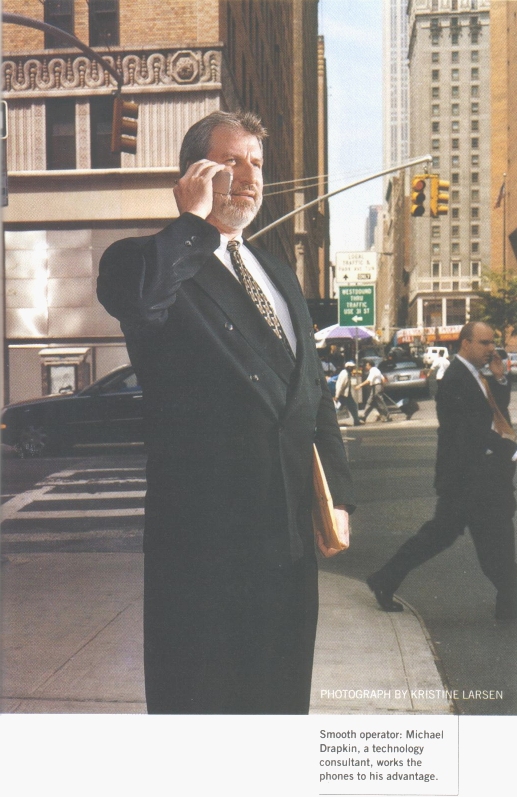
Subtitle: Forget about products and gadgets. Today's most successful entrepreneurs are building companies on one simple thing: what they know. Here's how you can too.
Quote: And consider having a graphic-design firm create your stationery. Michael Drapkin, a technology and management consultant in the New York City area, spent around $10,000 to have a professional design a Web site, business cards and letterhead for his company, Drapkin Technology. "It was very important for me in looking larger than I am, to establish myself as a serious player," says the 46-year-old entrepreneur.
If you work from home, it can be even more difficult to appear professional. Drapkin, who works out of a spare room, also invested in a $3,000 Toshiba telephone system, so he never misses a call. When someone leaves a message, the system calls Drapkin's cell phone to alert him to check his voicemail. To lend cachet to his company, he asked a friend-of-a-friend with a British accent to record an outgoing message.
What It's Like To Be A Twin
[Note: This was published in the CL Gazette - the official newspaper of Cherry Lane Elementary School. It appeared in a section called "All About Families..." and was penned (separately) by my twin daughters Sara and Leia.
By Sara Drapkin (4th grade)
Have you ever wondered about what it is like to be a twin? It can be a little annoying, but also 50 percent fun. My twin Leia always has to follow me everywhere - that's the annoying part about it. I would tell you everything about it but it would take too long. Everyone always gives us the same presents like we are the same people. And people always call me Leia and Leia, Sara (that is my name).
Sometimes we fight and call each other names, but somehow we always manage to make up. There's one good thing about school; being in different classes. I'm in Mrs. Manzare's class and Leia is in Ms. Esposito although we do sit together at lunch because we have many of the same friends.
Leia and I play pretty well sometimes. We like to play pinball together and play soccer, and we play school. It is fun always having a playmate around that knows you a lot. As I think about my sister, I realize that we are going to be twins forever. I have a twin and love it.
By Leia Drapkin (4th grade)
Have you ever wondered what it is like to be a twin? Being a twin can be a drag sometimes because people get us mixed up. Also, you have to share your birthday and friends with your twin. But I have to say that sometimes being a twin is also pretty fun.
When we were little we used to have a lot of fun together. When I was only 10 months old, I used to walk into my sister's bed during the night. My mom and dad would hear a thump on the floor and say, "there goes Leia again." We used to get in trouble together (and we still do sometimes). Once we were sledding down the hill and "bam" we slammed into a mailbox right by our neighbor's house. Luckily, I was in the back, but Sara came into the house dripping blood all over her face. Imagine that, saved by your twin!
Sara and I are quite different. She is a neat freak, and I am a little messy. I can stand cold water for a long time, but Sara can't. If the pool is cold, she is out of there in a flash. I'm pretty quiet (depending on where I am), but Sara likes to talk. Sometimes she can be a blabbermouth. She's definitely not afraid of meeting new people and speaking her mind.
So...as you can see there are good and bad things about being twins. 50% of the time I like it and 50% I don't. My twin, Sara, is pretty funny. All in all, being a twin is not so bad after all...I think I can get used to it.
Quotation in the Westchester County Business Journal
Shortly after the launching of this blog, I got a phone call from Alex Philippidis, a reporter at the Westchester County Business Journal. Alex had written a nice profile on me three years ago. He saw my notice about my blog and called me for commentary on an article he was writing. Here is the quote:
Pragmatix is one of many smaller application designers that have succeeded in the relatively narrow technology niche of developing application systems for businesses. Despite their size, companies like Pragmatix often attract as clients corporate giants that find it cheaper to outsource the applications they need developed than hire employees to do that work, said Michael Drapkin, chief executive officer of Drapkin Technology, a Monsey consultancy that specializes in Web business and e-commerce projects.
"Despite the fact the technology market has gone sour, there are always opportunities in the specialized or vertical market if you have specific expertise. Even in hard times, niche players can do well," said Drapkin, a former chair of e-commerce management at Columbia University's executive IT management program.
You can see the complete article at http://www.westchestercountybusinessjournal.com/landing_1.html
In Defense of Digital Downloads
[Note: Since my college days, I have been a member of the American Federation of Musicians - the musician's union. As a member of New York City Local 802, I receive their monthly newpaper called "Allegro." This is a letter I just emailed to their editor, Mikael Elsila, who wrote an article titled "New Contenders in the World of Digital Downloads." He just called me this morning (Tuesday, June 10) to tell me that they would like to publish it in its entirety as a guest column in an upcoming issue. Coincidentally, the New York Times published an article titled "In Battle Over Online Music, Industry Now Offers a Carrot" (June 8, 2003) which reinforces much of what I say below.]
Dear Mikael Elsila:
As a member of 802, I have read a number of pieces over the last year in Allegro union newspaper on the subject of digital downloads, and one of the common themes has been that digital downloads of music (and other media) over the internet is causing severe damage to the recording industry, and therefore to the recording 802 musicians income. I am sympathetic to my fellow musician's plight, but I strongly disagree with the positions you have taken.
It has yet to be proved that digital downloads cause the record companies damage. It is unproven that the downloaders would actually purchase the items they are downloading if they could not download them. In fact, the only actual study I have seen is a well known RIAA (Recording Industry Association of America) survey that came out several years ago that found that people who downloaded music off of the internet were far more likely to go out and purchase the music that they download than non-downloaders. Where is the damage? I believe that blaming downloaders for the ills of an already sick recording industry is shortsighted.
Another major point is that we are talking about an intellectual property issue, which is a complex issue that has dogged society since the first movable press hundreds of years ago. The interesting point here is that the issue at hand here only seriously affects the five major record labels - only five - who use a business model where very few of the recording artists ever see ANY financial benefit from their recordings. Everyone knows that bands make their money from tours, not records, unless you are a superstar. So the issue of damage here is really confined to a few huge corporations who exploit their artists, sell their music with no compensation, then cry crocodile tears that their intellectual property rights are being usurped.
But let's examine that issue. Are their rights being damaged? For several decades now, these same record companies have been distributing DIGITAL MASTERS of their intellectual property in the form of compact discs, and then complain when their fully unprotected raw digital media are being transferred through other kinds of digital media, such as the internet. They left themselves open for that, and because they have not done any due diligence in protecting their copyrighted intellectual property, they will ultimately fail in court. In order to defend your rights, one must show that they have taken all care in protecting their intellectual property, otherwise their rights will be held invalid. Distributing exact copies of digital masters via CD is no protection at all.
Another important issue that needs to be addressed is the five record company's attempts at restraint of trade by vigorously litigating against the file sharing systems through their attack dog, the RIAA. The issue here is preservation of their monopoly of distribution. These five labels are powerful because of their distribution ability, and their relative monopoly over it. The internet threatens that, and if artists can bypass them and distribute their own intellectual property directly to the public without having to go through a major record label, then why do we need major record labels? Don't forget that all these five labels do is provide distribution, and do not provide any compensation for the sales that they make to the large majority of recording musicians. Frankly, I think that their days are numbered, and these lawsuits are a feeble attempt to close the barn door after the cows are already out.
My last point is that I LIKE filesharing. It gives me access to things that would be otherwise impossible to obtain or cannot buy. For example, through filesharing you could download General Eisenhower's address announcing Operation Overlord - the invasion of Europe during WWII. It also allows one to promote yourself over the internet if you haven't signed with one of the major record labels. And, yes, just like the RIAA discovered, when I download a piece of music I like, I more often than not will go out and buy the recording.
I do agree with your last paragraph. The real issue is how will musicians be paid or otherwise compensated for creating music. New models will have to be developed, but as usual, that will have to wait until society to catches up with technology.
Jayson Blair Redux
With some fascination, I have watched all of the hubbub over the Jayson Blair scandal. Mr. Blair interviewed me and quoted me in a New York Times article titled “Behind Kozmo’s Demise: Thin Profit Margins” dated April 13, 2001.
A syndicated article appeared today called “The Trickster and why he fascinates us” by Mary McNamara of the Los Angeles Times, where she compares Mr. Blair to “tricksters” throughout history, including Frank Abagnale, Jr. of the “Catch Me If You Can” movie.
Mr. Blair’s April 13 2001 article was, in fact, accurate, and he did, in fact, quote me accurately. At least to me, the notion that Mr. Blair concocted everything that he wrote, or at least how he is being vilified in the press, leads me to question the motivations of those in the press calling for his crucifixion.
Don’t get me wrong, I do not condone falsehood, but he clearly did not falsify everything that he wrote, and certainly what he did was not illegal, or he would be in jail right now. Mr. Abagnale, Jr. – to whom he is directly compared – was eventually arrested and went to prison for his deceptions.
It leads me to the next question: is Mr. Blair being vilified because he really is the lone bad apple in a sea of immaculately accurate reporters, or is he being focused upon because he is a young, upwardly mobile black man and a convenient target? Hearing all of the self-righteousness coming out of the press makes me immediately wonder whether he is being made a scapegoat for practices that are far more common than the press would have us think. For example, where was the hew and cry about deception in the press when reporters gleefully reported the well-publicized staged pulling down of Saddam Hussein’s statue in Baghdad by Iraqis who were bussed by the U.S. military into an otherwise deserted square?
Maybe he is just a shill to distract us from press practices that may have been set for Mr. Blaire by older, less upwardly mobile non-black reporters and editors. I find it difficult to believe that he originated the idea of deception in the press.
A Letter to Dr. Joseph Polisi, President of the Juilliard School
[Note: this elicited an immediate call from Dr. Polisi, who proceeded to curse at me with phrases like "who the hell do you think you are?!?" I responded politely and in the appropriate way: I hung up on him in mid-curse.]
Dear Dr. Polisi:
I was pleased that you chose Renee Fleming to deliver your commencement address, and that she chose to focus on the very subject that my Performance Entrepreneurialism Program directly seeks to address.
Again, I challenge you: Will Juilliard remain a 19th century trade school, or will it join the 21st century and use its resources - the students - to lead a renaissance in the arts in America and give meaning to a degree from Juilliard?
"Renee Fleming
Opera singer
The Juilliard School, New York City
While you're standing in the grocery line holding Spam instead of foie gras for a few years ponder the following: Those of you who perform - musicians and dancers - will have by now practiced perhaps 3,000 hours a year, times 15 years, which equals 45,000 hours. Which means collectively that you as a group will have practiced 11 million hours. Challenge the idea that the arts are for a select few - teach, make more people love what you love, and help them to understand why you dedicated those 11 million hours in the first place. "
Regards,
mld
-----Original Message-----
From: Joseph W. Polisi [mailto:[email protected]]
Sent: Friday, May 30, 2003 4:47 PM
To: Michael Drapkin
Subject: RE: Follow up
Dear Mr. Drapkin:
I'm sorry I missed you on the telephone. Although it is highly unlikely that we can proceed with your proposal, I thought we left it that you were going to send me a draft syllabus for a course. However, as I said, it is not likely that we can proceed in the near future. Best, Joseph.
-----Original Message-----
From: Michael Drapkin [mailto:[email protected]]
Sent: Tuesday, May 27, 2003 11:52 AM
To: Joseph W. Polisi
Subject: Follow up
Dear Dr. Polisi:
Thank you for meeting with me a few weeks ago. I enjoyed presenting my Performance Entrepreneurialism Program to you and receiving your positive feedback.
I don't now where you are in the process of evaluating my proposal, but I felt I needed to give you some additional insight.
It is my understanding that protocol and economic challenges may dictate that it takes a certain amount of time for Juilliard to become comfortable with accepting and endorsing such a proposal as was presented. As we discussed in my presentation, this program is approximately 75% self-funding. If I found a way to enhance the funding of this program in
the early years to make it 100% self-funding, would that make a difference in the school's commitment to move forward today rather than at some undefined future date?
I would appreciate 15 minutes of your time on the phone to discuss my plan for making this program cash-flow neutral (or positive) and allow you to launch a groundbreaking leadership program at Juilliard during a time when the economic climate in New York City and indeed in America might make that difficult.
Please let me know when that time would be convenient for you.
Regards,
mld
Performance Entrepreneurialism Program
One of the disconcerting things about the classical music world and fine arts in general has been the gradual and continuing decline in or lack of funding for the arts in America, the dearth of opportunities for graduates of too many music schools, and the huge imbalance between the supply of these musicians and demand for their talents. To address this, I have developed a new curriculum for music schools called the Performance Entrepreneurialism Program or "PEP."
PEP is an entrepreneurship program. It is a curriculum designed to take music performance majors and turn them into entrepreneurs for the arts - to have them go out and create demand for their artistry, rather than merely pushing them out of school falsely believing that if they practice hard enough, someone will unceremoniously hand them a job.
To my great surprise, my proposed curriculum has been getting attention from the top music schools in the country. I have to admit that I am somewhat chagrined that I am getting far more traction from PEP than from my previously more lucrative and in demand technology leadership skills. I have now had numerous meetings with the heads of the Eastman School of Music (currently ranked as the number one music school in America by US News) and the Juilliard School. This is the classical music equivalent of meeting with the heads of Harvard and Yale.
You can view my Eastman and Juilliard PowerPoint presentations on the web. You will need to be using a recent version of the Microsoft Internet Explorer web browser on a PC (sorry Mac folks):
Juilliard Presentation - High bandwidth version, great graphics
Eastman Presentation - Low bandwidth version, quicker to load
Both versions are roughly the same; the Juilliard version is more recent and has better graphics, but it takes longer to load.
Two years ago, I gave the keynote speech at a symposium called Putting Your Degree to Work at the University of Texas College of Fine Arts in Austin as a guest of Bob Freeman, the former Director from Eastman, New England Conservatory, Dean of UT's College of Fine Arts, and a great friend and mentor (I will post my speech at a later date.) One of the questions I posed was as follows:
"In the eCommerce world, we have incubators which help nurture the growth of fledgling businesses. Where are the incubators of the music world?"
It also got me thinking about the huge imbalance between supply and demand in the classical music world. How in good conscience could music schools continue to pump thousands of graduates - particularly performance majors - year after year into a non-existent job market? It appeared as if they were all both acting for their own self-aggrandizement and self-perpetuation and still following a 19th European century model for music performance education: If you practice hard enough, someone/somewhere/somehow will give you a job playing your instrument.
Yet, at least in our society, this elusive job market simply does not exist. According to the American Symphony Orchestra League, there are only 22 orchestras with full year full time 52 week seasons in the United States. 22! That means that there are only roughly 60 full time jobs for symphony orchestra clarinetists in the entire country! You have better odds of becoming the Chief Executive Officer of a Fortune 500 company than landing a job as a clarinetist in one of these orchestras!
When I was Chair of eCommerce Management in Columbia University's Executive Information Technology Management program, I was tasked with taking technology managers and helping them span the wide gulf to becoming executives. I crafted curricula that were approved by Albany, I hired the instructors, which included MBAs from the Harvard Business School and NYU Stern, and taught a course called Web, Internet and eCommerce, where I examined the business models and infrastructure that makes up web commerce, as well as bringing in major guest lecturers from industry: CEO's, CIO's Directors of Marketing, VC's, etc.
This laid the foundation for the program that I felt was needed in higher music education. Students needed to learn the basics of business in order to forge their own path and ply their art, as well as to understand the motivations of their audiences and patrons. I believe that they needn't leave their destiny to chance and the good will of others. They need to become the masters of their own destiny! My program will teach them about how the world works - strategy, marketing, organization, operations, management, forming corporations, sales - things you need in order to start your own business, albeit not-for-profit. Plus, I would not even touch their traditional music curriculum, as well as make this program optional. My classes would replace some of the regimen of non-music academic courses that these schools must offer in order for them to be accredited academic institutions, therefore making this program largely self-funding. I would also have them perform a "Field Study," where they actually go out and either create a new ensemble or group or create something new in an existing organization. I would make it a contest, and the most successful group would win a large cash prize or Carnegie Hall Debut. Those students who choose not to participate in the PEP curriculum would not be eligible to compete in this contest.
Of course I am merely modeling many of the techniques used by schools that represent other industries. I have stolen shamelessly from the MIT Media Lab, the UCLA Business School and others. My hope is that the adoption of my program by a major school will be a watershed for the fine arts in America (of course this program is applicable to any of the performing arts: dance, theatre, etc.). It will force them all to not only adopt some version of the program I am proposing, but also make themselves accountable to their alumni. Did they prepare their graduates adequately to the task of plying their art in our society, not European society, which has heavy state support for the arts?
I believe there are large numbers of opportunities for young (or not so young) musicians to forge their own paths and create their own concerts, instead of abandoning responsibility for their careers to the all or nothing lottery of the very few symphony orchestra jobs. These may not be lucrative enough opportunities to warrant the attention of concert promoters because of the low commissions yielded against the effort spent organizing small concerts. But if the performers could promote and organize these venues themselves, they could actually discover a way to earn a living as a performer. The ultimate success of my curriculum would be for the field study to turn into the job that they assume upon graduation. Imagine that - your field study turns into your livelihood! Imagine all of these entrepreneurial graduates fanning out across the country, starting a rebirth of fine culture in America through their home-grown concerts!
The last "deal sweetener" I came up with, most recently with the Director of the Eastman School of Music, was to present a way for my program to be self funding. As I discuss in my presentation, this program is approximately 75% self-funding. If I found a way to enhance the funding of this program in the early years to make it 100% self funding, I believe that would make a difference in a school's commitment to move forward today rather than two years from now. What I have proposed is coming up with an endowment through my personal resources or the personal resources of people I know who may be passionate about seeing such a project to fruition. I have some planned giving specialists at Merrill Lynch who have committed to helping me obtain commitments from charitably inclined individuals, family foundations and corporations to help endow my program.
While the last two years have been an unmitigated business disaster for me because of the meltdown in the technology world, especially in the New York City area, it has given me the rare opportunity to conceive ideas like the curriculum I have presented above and in my PowerPoint presentations. If I was involved in the usual all-consuming technology leadership position, I would never be given pause to conceive and refine an idea like this. It may sound cliche, but there is always a silver lining to every cloud. I am quite excited about the potential of this kind of challenge, and in addition to my ongoing technology job search activities, I believe I am making greater progress towards this particular endeavor, plus for the first time in twenty years I am seeing a model that would return me to earning my living through music - my first career - while combining the sum of the skills I have obtained across all of my personal reinventions. In a sense, it is a much more worthy goal. I know I won't change the world through the tech work I do, but it does provide income. On the other hand, I believe that the PEP program has the potential to make a fundamental positive change in an area that is of great importance to me. Perhaps in the long run that is much more important.
Eloquent Response to "The Pledge"
I got a lot of responses to my initial posts, and they were overwhelmingly positive. Here is a particularly good excerpt from a note Steve Bixby sent me. He said "I would rather see a pledge of remembrance of what makes this country great:"
I pledge I will remember those who gave their lives and fortunes to establish and defend my rights. I pledge I will remember that we are a generous people with the opportunity to turn our blessing into blessings for others. I pledge I will remember that my parents and grandparents had a dream of a "good life" that was worth working for, and there are few places in the world where that pursuit is unrestricted. I pledge I will be tolerant of others rights, views, and will honor the personal freedoms that all people should enjoy. If one day should pass that I have forgotten these, let me stand and recall them to be always appreciated and remembered.
Excellent, Steve!
A child calls for peace
[Note: This was written by my 10 year old daughter Sara, and it was published in the Rockland Journal News on Thursday, May 8, 2003. She came up with the idea totally on her own, and we are all very proud of her.]
I am in the fourth grade, and I want to share with everyone that I am so proud of my religion. But a lot of people don't like my religion. I am Jewish.
There are a lot of people who hate Jews. Well, they are people just like everyone else. I was created on this earth with everyone else, and there is no peace. And I don't understand why. There should be peace no matter where you're from or what your background is.
From every religion there are sweet and nice people.
Why is it so difficult to have a relationship with someone who does not have the same religion? We are people. Don't we count?
I can tell you many fascinating things about Jews. Jews and Christians have so many similarities. One is that we both have a holiday that has presents.
You know God put us on the land to live a good life, and so far there is not much peace out of people. So, think about peace. If there is someone who you have been mean to, maybe you can resolve things. One person or two could change the way they live. No matter who you are, don't judge by religion; judge by the inside.
I Pledge What?
[Note: The Rockland Journal News refused to publish this one.]
With some perplexity, I read about the 9th US Circuit Court of Appeal's ruling that the words "under God" made the Pledge of Allegiance unconstitutional. After reading it, I wasn't confused about the "under God" part, which was tacked on during the Eisenhower administration to distinguish us from "godless Communism" but why we have to have a Pledge of Allegiance to begin with. Can someone please explain that to me?
The United States, a democracy, exists for the benefit of its citizens, not the other way around. When I was a little kid, whenever we had an assembly in school, some kid would get up front and call out "hand over heart, ready, begin!" and we would boringly recite the Pledge. We make it compulsory for our children to recite the Pledge in school, yet when one is being coerced into making any kind of pledge, then isn't it meaningless? A pledge is supposed to be voluntary, like the one immigrants make when they "volunteer" to become citizens of the United States. No one is holding a gun to their head, telling them they must become citizens and swear allegiance to our country. I was born here, and my citizenship is guaranteed under the Constitution; I don't have to continually make a pledge in order to renew this right!
I tried to explain the Pledge to my children a few years ago, breaking down the meaning of each word, but I lost their attention about halfway through the convoluted wording. Frankly, I think there are much better pledges that we should make compulsory, rather than this one:
- The Pledge of Monogamy. Make married men recite their marriage vows each day before they go out, and again if they call their wives and tell them they have to work late.
- The Pledge of Cleanliness. All kids living at home must pledge to clean up their rooms and pick their stuff up from around the house. And if it is cold out, they must wear a hat even though it messes up their hair.
- The Pledge of Celibacy. Young men must swear this to the fathers of their dates; more effective with a shotgun in view. Related to the "Pledge of Birth Control."
- The Oath of Office. Make our politicians constantly recite the pledge they made when they were sworn in - to work for our benefit, not theirs. Given all the scandals we've seen, this is badly needed. Of course, like when our kids are coerced to say the Pledge in school, they probably won't pay attention here either.
I think the hoopla over the Pledge of Allegiance is silly, since anyone who really thinks about what it means sees that it is backwards - that it is the Republic that needs to be regularly reminded to swear allegiance to and govern for the benefit of its consenting citizens.
Greetings!
Here is my new weblog (or "blog" as it is referred to in the vernacular).
I got tired of pitching editorial ideas or sending in editorials that don't get published (although, to be perfectly fair, with Sara's recent letter to the editor in the Rockland Journal News, we are collectively 2 for 4 there). Ergo, I have created this log as a way of communicating that which I care to express to my friends, family and loyal readership.
I plan to quickly post many of my unpublished pieces, and have many ideas for new ones. As always, drop me an email with your comments to [email protected].